Este artículo está disponible solo en inglés.
Short answer: Nobody can make ChatGPT name your agency, and OpenAI has not published how it chooses. But when an agency never shows up, the cause is usually something you can see from the outside: the site shuts out ChatGPT's search crawler, the page is built with JavaScript so a crawler reads almost nothing, or the page never says in plain words what you sell and where. Those you can check in a minute and fix.
The crawler and search details below come from the companies' own pages as they read on 23 October 2026: OpenAI's Overview of OpenAI Crawlers and Searching the web with ChatGPT, and Google's AI features and your website. The Medicare rule is 42 CFR 422.2267. These pages change, so check them if something here no longer matches.
Why do insurance agencies get left out of ChatGPT's answers?
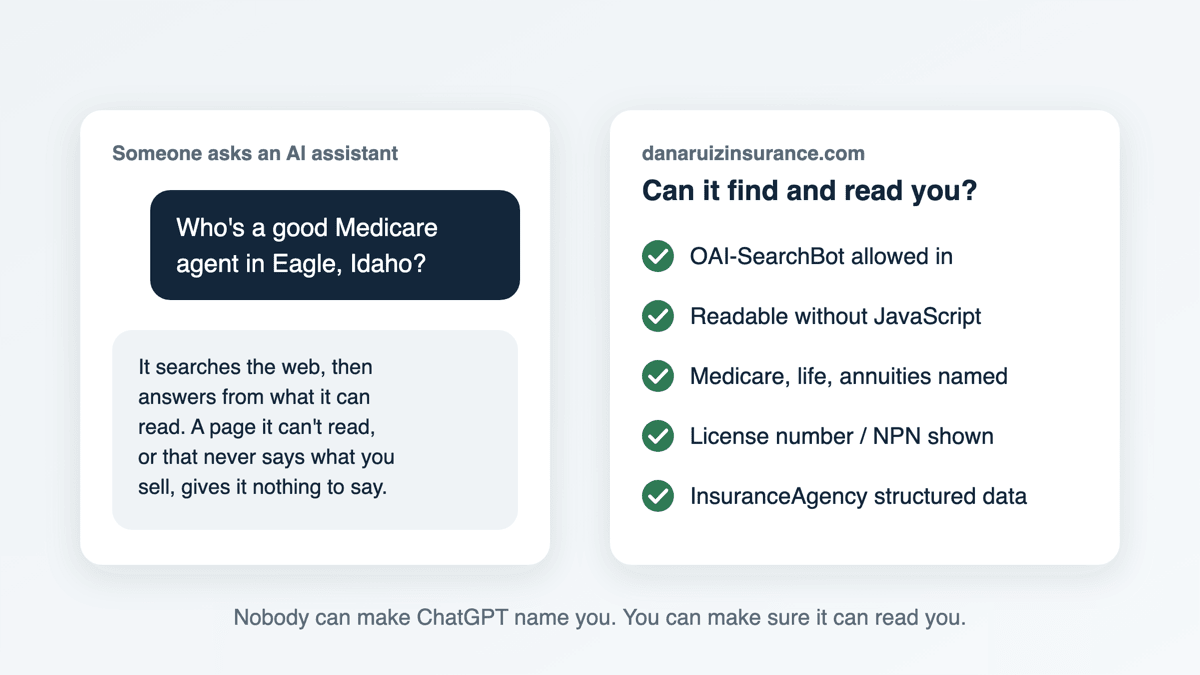
When someone asks ChatGPT something that needs current information, such as "who is a good Medicare agent in Eagle, Idaho?", it can search the web and answer with links to its sources. It can only use what that search finds and what its crawler is allowed to read. An agency site that cannot be read, or that never says what it does, gives it nothing to repeat. Each question below is one of those reasons.
Is my website letting ChatGPT in?
This is the one thing fully in your control. OpenAI uses a crawler called OAI-SearchBot for ChatGPT's search. Its crawler page says sites that opt out of OAI-SearchBot "will not be shown in ChatGPT search answers". A separate crawler, GPTBot, is for training OpenAI's models. The two are independent: you can block GPTBot and still allow OAI-SearchBot. OpenAI says a change to your robots.txt file takes about 24 hours to take effect.
To check, open youragency.com/robots.txt in a browser. If you see OAI-SearchBot followed by Disallow: /, or User-agent: * followed by Disallow: /, you are shut out. A firewall or bot-protection setting at your host can also turn crawlers away when robots.txt allows them. Perplexity's crawler page explains allowing its bots in exactly that case, and the same applies to the others. Many agency sites are built and hosted by a carrier, an FMO or a marketing company; if yours was, ask them which crawlers it lets in.
Can a crawler read my page without JavaScript?
Some site builders send an almost empty page and draw the words in afterwards with JavaScript. A person sees a normal site. A crawler that does not run the script reads close to nothing: no name, no phone number, no lines of insurance. To get an idea of what a crawler gets, open your home page, choose "View page source" in your browser, and search for your agency's name and phone number. If they are not in the source, a crawler may not be getting them either.
Does my page say what I sell, and where?
ChatGPT turns a question into searches for a kind of agent in a named place, so a page has to say both in words. "Protecting what matters most" does not tell anyone that you write Medicare supplements in Ada County. Name the lines you write (Medicare, life, annuities, home, auto, commercial, whatever is true), the towns or counties you serve, and the states you are licensed in, in plain text on your home page. Give each line a page of its own that answers the questions people actually ask about it.
Can someone check that I am licensed?
A careful client, and anyone building an answer about you, can look up an insurance producer, but only with something to look up. Every licensed producer has a National Producer Number, which NIPR explains here, and each state issues the license itself. Put your license number with its state, or your NPN, in the footer and on your contact page. Several states also require the license number in advertising, and a website can count; our article on what Florida requires on an insurance agent's website covers one state in detail.
Does my structured data say I am an insurance agency?
Structured data is a short block of code that labels a page for machines. Schema.org has a type for exactly this, InsuranceAgency, which sits under LocalBusiness and FinancialService. It carries your name, address, phone, the area you serve and more. Google's AI features page says no special markup is needed to appear in AI Overviews, and that any structured data you have must match the visible text on the page. So it labels a page clearly, which does no harm, but it will not rescue a page that does not say the same things in words.
While I am on my Medicare page, what else should be there?
This one is not about ChatGPT, but the same look at your site will show it. If you sell Medicare Advantage or Part D plans for more than one carrier, CMS treats you as a third-party marketing organization, and 42 CFR 422.2267(e)(41) requires a standard disclaimer that begins "We do not offer every plan available in your area", with the number of organizations and plans you represent filled in. The rule says it must be "prominently displayed" on your website. Your FMO or carrier can give you the current wording for your situation.
How do I check all of this in one go?
We built a free website checker for insurance agents. Put in your address and it reports what it can see from the outside: whether robots.txt lets OAI-SearchBot and the other AI crawlers in, whether the page can be read without JavaScript, whether it names the lines you write, whether a license number or NPN is visible, whether your structured data says InsuranceAgency, whether a page that offers Medicare plans carries the CMS disclaimer, and the basics underneath: your email records and your domain's expiry date. It is free, needs no sign-up and stores nothing. It reports what is visible; it is not a compliance review.
What nobody can promise you
OpenAI has not published how ChatGPT decides which agencies to name, or in what order. Anyone selling a guaranteed ChatGPT recommendation is guessing, and you cannot check their claim. Answers also differ from one person to the next: OpenAI's help page says ChatGPT can use a person's approximate location, and it warns that search results "can be incomplete, outdated, or incorrect". So asking ChatGPT about your own agency once and getting a result, good or bad, does not tell you what a client in another town will see tomorrow.
What you can control is the groundwork: the crawler allowed in, a page a crawler can read, plain words about what you sell and where, a license number a client can check, and the same name, phone number and address everywhere you are listed. Google's own advice ends in the same place: the fundamentals that get a page found in ordinary search are the ones that get it used in AI answers.
Swift Agent Sites builds sites for insurance agents: $89 a month or $890 a year with no setup fee, your own domain, hosting and https included, usually live the same day, in English, Spanish or both, with a contact form that sends quote requests straight to you.
Related: