Este artículo está disponible solo en inglés.
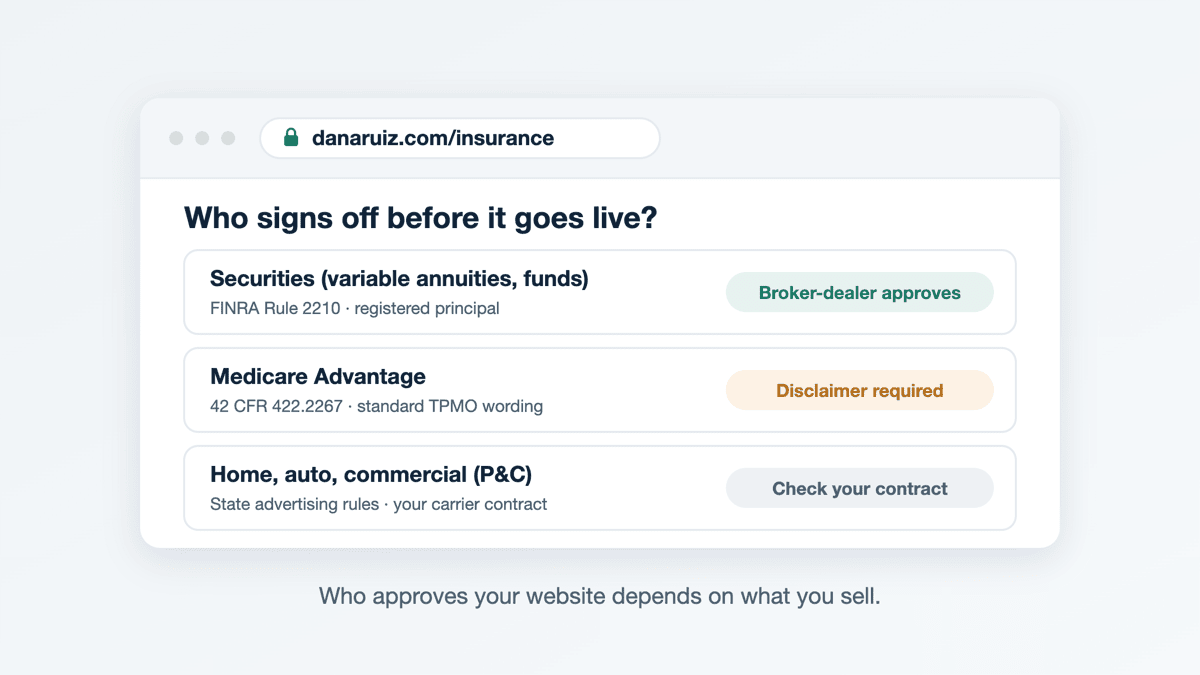
Short answer: it depends on what you sell, not on the website. If you sell securities products, your broker-dealer must approve the site before it goes live. If you sell Medicare Advantage, the site needs a federal disclaimer. Property and casualty agents usually need no pre-approval, but still answer to state advertising rules and their carrier contracts.
Most agencies sell more than one line, so more than one of these can apply at once. Work through them in order, starting with the strictest.
Do I sell variable products or other securities?
If you are a registered representative, for example you sell variable annuities, variable life or mutual funds through a broker-dealer, your website falls under FINRA Rule 2210.
- A public website is a retail communication: the rule's line is anything made available to more than 25 retail investors within 30 days, and a website is open to everyone.
- A registered principal must approve each retail communication before it is first used, apart from a few narrow exceptions. In practice that means your broker-dealer's compliance department.
- The firm has to keep a record of what was approved, by whom and when.
This applies to the whole site, not just the pages about securities. A "Home" page with your photo and your list of services is still a communication from a registered rep. Send compliance the full site, not a page at a time.
What if my website only covers home and auto insurance?
If you are registered with a broker-dealer, ask compliance anyway. Firms commonly require approval of any outside website a registered rep runs, whatever it advertises, because the rep's name is attached to the firm. If you are not registered with FINRA at all, Rule 2210 does not apply to you.
Do I sell Medicare Advantage plans?
Federal rules call independent agents and brokers who are paid to market or enroll people in Medicare Advantage plans third-party marketing organizations, or TPMOs. If you sell plans for more than one Medicare Advantage organization, 42 CFR 422.2267(e)(41) requires a standard disclaimer to be prominently displayed on your website.
The wording is fixed. If you do not sell every plan in the area, it says you do not offer every plan available, how many organizations you represent and how many products they offer in the area, and that the reader can contact Medicare.gov or 1-800-MEDICARE for all their options. If you do sell every plan, a shorter version applies. Fill in the two numbers, keep them current each year, and do not paraphrase the rest.
Do my Medicare pages need to be submitted to CMS?
Pages that are marketing in the federal sense do. Under 42 CFR 422.2260, that means material meant to draw attention to a Medicare Advantage plan or influence someone's choice of plan, and that talks about things like the plan's benefits, premiums, cost sharing or Star Ratings. Such material goes to CMS for review through the plan's marketing system, either by the plan or by the marketing organization after each plan has reviewed it, as 42 CFR 422.2261 describes.
The practical split:
- Usually fine without submission: "I help people in Broward County compare Medicare options. Call me." No plan names, no benefits, no premiums.
- Needs to go through the plan: "Plan X has a $0 premium and dental included." Named plans and their benefits are marketing.
If you want plan details on your site, talk to the plans or your FMO first. Most agents keep the website general and save plan specifics for the appointment.
What if I only sell property and casualty?
For home, auto, commercial and other P&C lines, there is usually no regulator that approves your website before it goes live. That is not the same as no rules:
- State advertising rules still apply. Every state regulates insurance advertising through its unfair trade practices law and its department of insurance, and some require license details on ads. Check your own state's department of insurance.
- Your carrier and agency contracts may require approval. Captive agents in particular should read their agent agreement and the company's marketing guidelines before publishing anything with the company's name or logo on it.
- Your E&O carrier may have opinions. Claims like "best price guaranteed" or "full coverage" are the kind of wording that causes trouble later. Say what you do, not what every policy will do.
Do I need approval again if I move my website to a new platform?
Treat a move as a new website. If your broker-dealer approved the old site, send them the new one before it goes live, even if the words are the same: the layout, links and forms are part of what they approve. Check that the Medicare disclaimer and your license details made it across. Check vendor content separately: if the old platform supplied your articles, they may not come with you, and anything new needs approval like the rest.
Can I write my own website copy if compliance has to approve it?
Yes. Approval is about reviewing what you publish, not about who writes it. Plain, specific copy (who you are, where you are licensed, which lines you write, how to reach you) is also the fastest to approve. The longer and more promotional the copy, the more there is to send back.
What should every insurance website have, whatever I sell?
- Your name, the states you are licensed in and your license number.
- Any disclaimer your broker-dealer, the Medicare rules or your carrier require, on every page where it applies.
- A quote or contact form that asks only for what you need to call back.
- A dated record of what you published and who approved it. Keep a PDF of each version.
Swift Agent Sites builds sites for insurance agents too: $89 a month or $890 a year with no setup fee, your own domain, hosting and https included, usually live the same day, in English, Spanish or both, with a contact form that sends leads straight to you.
Related: