Este artículo está disponible solo en inglés.
For an independent insurance agent or small agency in 2026, a purpose-built insurance website costs roughly $1,000 to $3,600 in the first year, and the honest short list is small. InsuranceSplash is the cheapest insurance-specific platform that publishes its price, at $89/month with no setup fee. BrightFire runs $170/month, no setup fee. Forge, Agency Revolution's insurance-only platform (formerly Forge3 ActiveAgency), starts at $140/month plus a $500 setup fee. Advisor Evolved is the most design-custom of the group and also the most expensive to start: $1,800 setup plus $150/month for Quick Launch, or $5,600 setup plus $350/month for a custom build. If you want a professional site without a monthly subscription at all, Swift Agent Sites builds one for $89/month, or $890/year, with no setup fee. Prices verified September 2026; Forge's corrected on 7 October 2026; our own updated on 8 October 2026.
The rest of this page explains what the higher prices actually buy, when they are worth it, and what a solo agent should skip.
What does an insurance agent website cost in 2026?
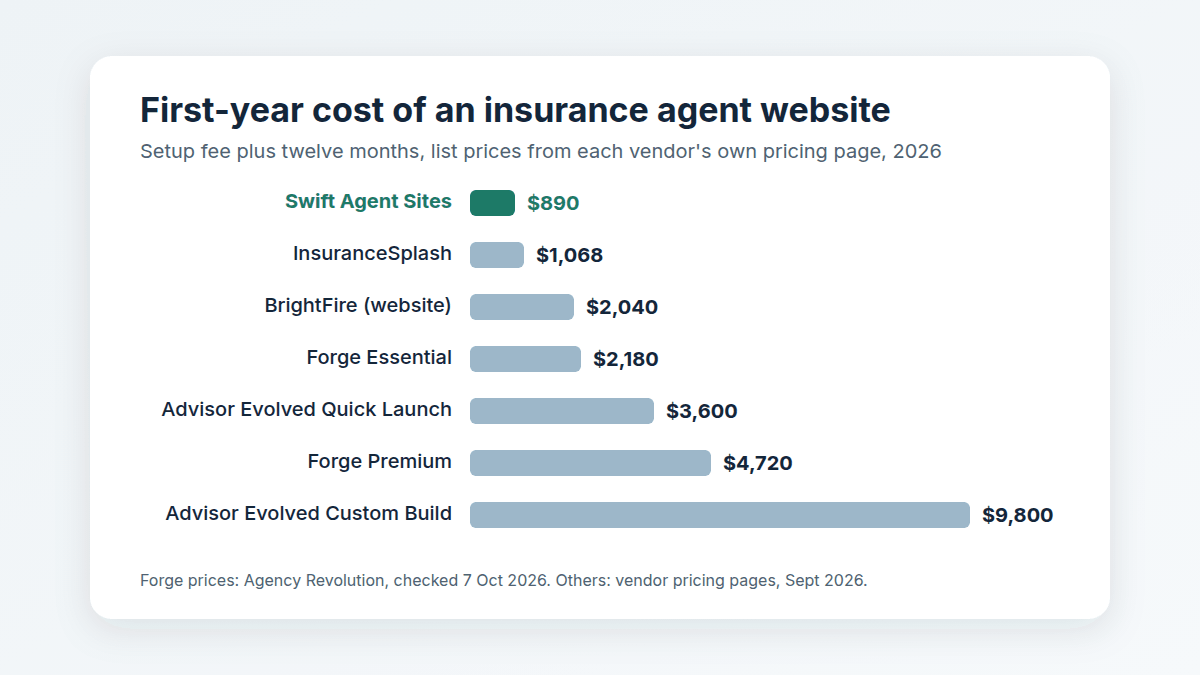
Here is what each platform charges, with the first-year total worked out so the setup fees are visible. These are list prices taken from each vendor's own pricing page in September 2026.
- InsuranceSplash — $89/month, no setup fee, no contract. First year: $1,068.
- BrightFire (website only) — $170/month, no setup fee, no contract. First year: $2,040.
- BrightFire "Ultimate SEO Bundle" — $290/month, which adds reviews management and local listings management. First year: $3,480.
- Forge Essential (Agency Revolution) — from $140/month plus a $500 setup fee. First year: $2,180, then $1,680/year.
- Forge Premium — from $310/month plus a $1,000 setup fee; adds business texting, local listings and reputation management. First year: $4,720, then $3,720/year.
- Advisor Evolved Quick Launch — $1,800 setup plus $150/month, 20–30 day turnaround. First year: $3,600, then $1,800/year.
- Advisor Evolved Custom Build — $5,600 setup plus $350/month, 30–90 day turnaround. First year: $9,800, then $4,200/year.
- AgentMethods — does not publish pricing; it quotes after a demo. Third-party software directories list a Foundation tier from $149 and an AMPlify tier at $299, but the billing period is not stated, so treat those as unconfirmed.
- Swift Agent Sites — $89/month, or $890/year, no setup fee, no contract. First year: $890.
Two things stand out. First, insurance-specific platforms cost two to six times what a comparable real estate agent site costs — we broke that market down separately in How much does a real estate agent website cost in 2026, and the gap is real, not a rounding difference. Second, setup fees have not gone away: Forge charges $500 or $1,000 up front and Advisor Evolved $1,800 or $5,600, while InsuranceSplash and BrightFire charge none. Advisor Evolved's custom-build fee is the largest single line item in this whole comparison.
What are you actually paying for at $150 to $300 a month?
It is worth being fair about this, because the expensive platforms are not simply overcharging. The recurring fee on Forge, BrightFire and AgentMethods largely buys content you are not writing and compliance exposure you are not taking on:
- Pre-written, licensed product content. Pages explaining homeowners, commercial auto, workers' comp, umbrella and the rest — written for insurance and updated over time. Writing thirty of those yourself is genuinely weeks of work.
- Agency-management and rater integrations. Forge lists integrations with agency systems on its product page; BrightFire and others plug into common agency systems. If your quote flow needs to land somewhere other than an email inbox, this matters.
- Policy service centers. Logged-in areas where clients request certificates, ID cards and policy changes. Advisor Evolved and Forge (its self-service client center) both include one.
- Ongoing blog and SEO content. BrightFire includes weekly posts in its recurring fee.
The question is not whether that is worth $2,000 to $4,000 a year. It is whether you will use it. A captive agent writing personal lines in one town, whose leads come from referrals and a Google search for their own name, will use almost none of it. A ten-producer independent agency writing commercial lines across three states will use most of it.
Should an insurance agent just use Wix or Squarespace?
You can, and it is much cheaper: Squarespace runs $19–$99/month on annual billing, and Wix's paid plans start around $18/month. But three things go wrong often enough to be worth naming.
- You write every word. There is no insurance content library. The blank page is the actual cost.
- The trust signals are on you. License numbers, carrier relationships, disclosures and a quote form that routes correctly are all manual.
- Maintenance quietly becomes your job. Plugins, forms breaking, an SSL warning nobody notices for a month.
DIY is the right answer when you enjoy the work or your budget is genuinely near zero. For most producers, the useful comparison is not DIY versus a $150–$300/month platform — it is DIY versus a done-for-you site at the bottom of this market, which is the gap Swift Agent Sites was built for at $89/month, or $890/year.
What has to be on an insurance agent's website?
Licensing disclosure rules are set by each state's insurance department, and they vary more than agents expect. New York's Department of Financial Services addressed this directly in OGC Opinion No. 03-12-17: it concluded that New York Insurance Law does not mandate specific website disclosures, but advised that agents and brokers prudently display information from their license — name, business address, state of licensing, license type, license number and expiration date. Other states are stricter. Check your own state's department of insurance rather than assuming.
Beyond disclosure, the practical list for an agent site is short:
- Your name, photo and the states you are licensed in — above the fold, not on an "About" page.
- Your producer license number(s), displayed plainly.
- A phone number that is tappable on mobile, since a large share of insurance inquiries are still calls.
- A quote request form that asks for less than you want. Name, phone, line of business. Every extra field costs you submissions.
- Carrier logos only if you have permission. Most carriers publish brand and marketing guidelines governing appointed-agent use of their marks; using a logo you are not authorized to display is a real problem, not a theoretical one.
- Real reviews with real names. Insurance buyers are unusually sensitive to this.
Do you need your own site if your agency gives you one?
Usually yes, for the same reason a real estate agent needs one alongside the brokerage page — the agency's page belongs to the agency, and your name comes off it the day you leave. We worked through that argument in detail in Do I need my own website if my brokerage gives me one?, and it transfers almost exactly to captive and franchise insurance models.
The one thing to check first is your carrier or agency agreement. Captive agents in particular often face approval requirements on independent web presence and advertising. Ask before you build, not after.
How do insurance agents get found locally?
Your website is the destination, not the traffic source. The single highest-return step for most agents is a Google Business Profile in your own name — and Google's own guidelines specifically name insurance agents as individual practitioners who may have a profile separate from their agency, which we covered in Can an agent have their own Google Business Profile?. That profile is where reviews accumulate and where "insurance agent near me" searches land.
Two supporting pieces are worth the effort: an email address on your own domain rather than a Gmail or a carrier address you will lose — the options and DNS setup are compared in our 2026 agent email price comparison — and a site structured so AI assistants can quote it, since a growing share of insurance questions now get answered by an assistant rather than a results page. Our explainer on answer engine optimization covers what that actually requires.
Which one should you pick?
- Multi-producer independent agency, commercial lines, needs rater and AMS integration — Forge Premium at $310/month plus $1,000 setup (Essential, at $140/month plus $500, if you can do without texting and reviews), or BrightFire at $170/month if you want marketing services bundled.
- Small agency that wants insurance content without the top-tier price — InsuranceSplash at $89/month.
- Agency where the site is a core brand asset and the budget exists — Advisor Evolved Custom Build, accepting the $5,600 setup.
- Solo producer whose leads come from referrals, who wants a credible site at the lowest price in this table — Swift Agent Sites at $89/month, or $890/year paid annually.
- Brand-new agent with no budget and some patience — Squarespace or Wix, and accept that you are writing the content.
Frequently asked questions
How much should a solo insurance agent spend on a website?
Between $890 and $1,100 a year covers a professional, credible site from either a flat-fee builder or the entry insurance platforms. Spending past $2,000 a year only makes sense once you are using the carrier integrations, policy service center or bundled marketing services that money buys.
Do I have to display my license number on my website?
It depends on your state. New York's DFS has advised that it is prudent but not legally mandated there; other states impose firmer advertising and disclosure requirements. Display it regardless — it is a trust signal as much as a compliance one — and confirm the specifics with your state's department of insurance.
Is a website with carrier quoting built in worth the extra cost?
Only if you would otherwise lose the lead. Real-time quoting raises cost and complexity considerably. For most personal-lines producers, a simple quote request form that reaches you within minutes converts comparably and costs a fraction as much.
How long does it take to get an insurance agent website live?
Platform sites typically run one to four weeks. Advisor Evolved publishes 20–30 days for Quick Launch and 30–90 days for a custom build. Flat-fee builders are faster — Swift Agent Sites sends a preview link by email within three business days.
Can I move my site later if I switch platforms?
Your domain and your content move with you; the design and any platform-specific tools do not. This is the strongest practical argument for registering your domain in your own name rather than letting a vendor hold it, whichever platform you choose.
Do insurance agents actually get leads from their websites?
Directly, rarely in volume. Indirectly, constantly — prospects who found you by referral or Google Business Profile check your site before calling, and that is where the sale is won or lost. Judge the site on whether it closes referrals, not on raw form fills.
Get a site built for you
Swift Agent Sites builds sites for independent real estate, insurance, consulting and talent agents at $89/month, or $890/year, with no setup fee, with a free preview link emailed within three business days. See plans and start your free month →
Sources
- InsuranceSplash — Insurance Websites Built Exclusively for Insurance Agencies
- BrightFire — Pricing
- Agency Revolution — Forge insurance agency websites and pricing
- Advisor Evolved — Website Plans & Pricing
- AgentMethods — Pricing
- GetApp — AgentMethods Pricing Plan & Cost Guide
- Squarespace — Pricing
- Wix — Plans and Pricing
- New York Department of Financial Services — OGC Opinion No. 03-12-17, Web Site Disclosure Requirements for Insurance Agents and Brokers
- Swift Agent Sites — Pricing