The best insurance agent websites in 2026 come from a short list of insurance-only platforms: InsuranceSplash, BrightFire, Forge (Agency Revolution), AgentMethods and Advisor Evolved, and an entry plan on any of them costs roughly $1,000 to $3,600 in the first year. InsuranceSplash is the cheapest that publishes its price, at $89/month with no setup fee, and Advisor Evolved is the most custom and the most expensive to start, at $1,800 setup plus $150/month.
In between, BrightFire runs $170/month with no setup fee, Forge starts at $140/month plus a $500 setup fee, and AgentMethods, which now publishes its prices, starts at $199/month plus a $499 setup fee on an annual term ($179/month if you pay for the year up front). If you want a done-for-you site without a monthly platform fee, Swift Agent Sites builds one for $890 a year, with no setup fee. Every price on this page was rechecked on the vendor's own pricing page on November 3, 2026.
The rest of this page explains what the higher prices actually buy, when they are worth it, and what a solo agent should skip.
What does an insurance agent website cost in 2026?
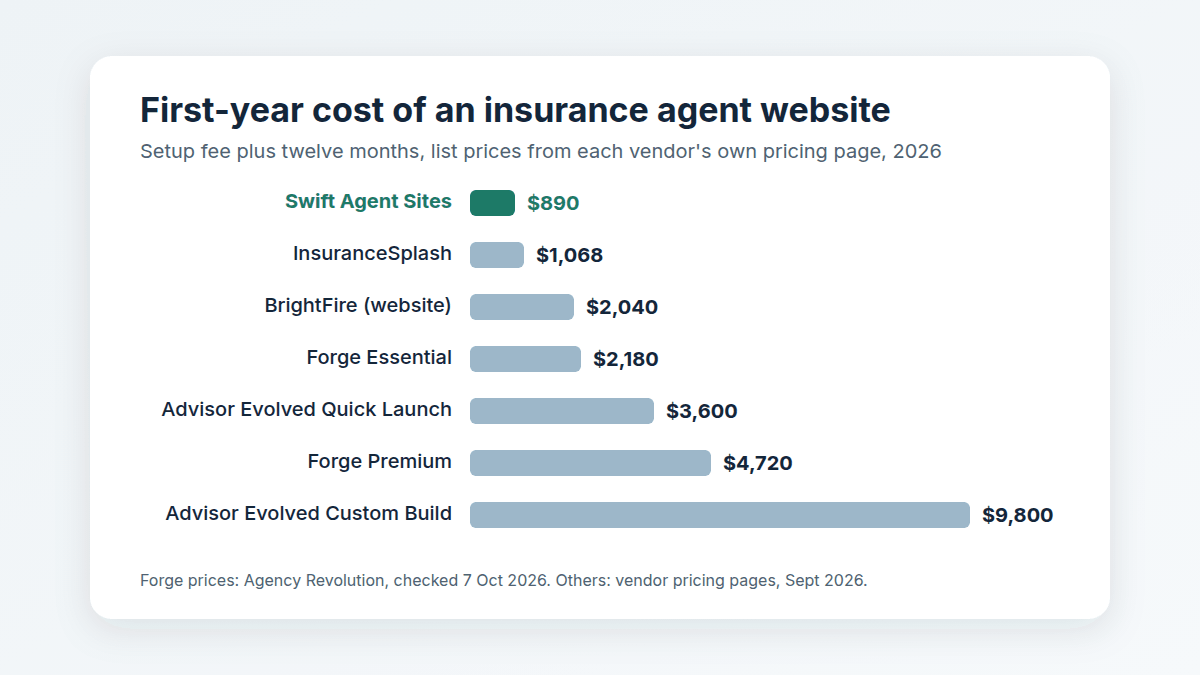
Here is what each platform charges, with the first-year total worked out so the setup fees are visible. These are list prices from each vendor's own pricing page, read on November 3, 2026. First-year totals are the setup fee plus twelve months.
- InsuranceSplash: $89/month, no setup fee, no contract. First year: $1,068.
- BrightFire (website only): $170/month, no setup fee, no contract. First year: $2,040.
- BrightFire "Ultimate SEO Bundle": $290/month (listed down from $330), which adds reviews and reputation management and local listings management. First year: $3,480.
- Forge Essential (Agency Revolution): from $140/month plus a $500 setup fee. First year: $2,180, then $1,680/year.
- Forge Premium: from $310/month plus a $1,000 setup fee; adds business texting, local listings and reputation management. First year: $4,720, then $3,720/year.
- AgentMethods Launch: $199/month plus a $499 setup fee, on an annual term; $179/month billed annually. First year: $2,887 paid monthly, or $2,647 paid annually.
- AgentMethods Scale (website, marketing and appointments): $399/month plus a $999 setup fee; $359/month billed annually. First year: $5,787 paid monthly, or $5,307 paid annually.
- Advisor Evolved Quick Launch: $1,800 setup plus $150/month, 20–30 day turnaround. First year: $3,600, then $1,800/year.
- Advisor Evolved Custom Build: $5,600 setup plus $350/month, 30–90 day turnaround. First year: $9,800, then $4,200/year.
- Swift Agent Sites: $890/year, no setup fee. First year: $890.
Two things stand out. First, insurance-specific platforms cost two to six times what a comparable real estate agent site costs. We broke that market down separately in How much does a real estate agent website cost in 2026, and the gap is real, not a rounding difference. Second, setup fees have not gone away: Forge charges $500 or $1,000 up front, AgentMethods $499 to $999 and Advisor Evolved $1,800 or $5,600, while InsuranceSplash and BrightFire charge none. Advisor Evolved's custom-build fee is the largest single line item in this whole comparison. (AgentMethods also lists a $299/month Accelerate plan, but it is marketing automation for an agent who already has a site, so it is left out of the totals.)
What the $150 to $400 a month buys
It is worth being fair about this, because the expensive platforms are not simply overcharging. The recurring fee on Forge, BrightFire and AgentMethods largely buys content you are not writing and compliance exposure you are not taking on:
- Pre-written, licensed product content. Pages explaining homeowners, commercial auto, workers' comp, umbrella and the rest, written for insurance and updated over time. Forge lists 200+ coverage pages in every plan. Writing thirty of those yourself is genuinely weeks of work.
- Agency-management and rater integrations. Agency Revolution shows integrations with AMS360, Applied, EZLynx, HawkSoft, QQCatalyst and AgencyZoom, among others; BrightFire says its platform integrates with comparative raters and agency management systems. If your quote flow needs to land somewhere other than an email inbox, this matters.
- Policy service centers. Logged-in or self-service areas where clients request certificates, ID cards and policy changes. Advisor Evolved includes a Policy Service Center in all plans, and every Forge plan includes a self-service client center.
- Ongoing blog and SEO content. BrightFire lists weekly blog posts as part of its website service.
The question is not whether that is worth $2,000 to $5,000 a year. It is whether you will use it. A captive agent writing personal lines in one town, whose leads come from referrals and a Google search for their own name, will use almost none of it. A ten-producer independent agency writing commercial lines across three states will use most of it.
Should an insurance agent just use Wix or Squarespace?
You can, and it is much cheaper: Squarespace runs $19–$99/month billed annually ($25–$139 month to month), and Wix has a free plan plus paid plans priced by country, so check wix.com/plans for yours. But three things go wrong often enough to be worth naming.
- You write every word. There is no insurance content library. The blank page is the actual cost.
- The trust signals are on you. License numbers, carrier relationships, disclosures and a quote form that routes correctly are all manual.
- Maintenance quietly becomes your job. Plugins, forms breaking, an SSL warning nobody notices for a month.
DIY is the right answer when you enjoy the work or your budget is genuinely near zero. For most producers, the useful comparison is not DIY versus a $150–$400/month platform; it is DIY versus a done-for-you site at the bottom of this market, which is the gap Swift Agent Sites was built for at $890 a year. Whichever you choose, our free insurance website checker shows whether the finished site displays a license number or NPN, carries the Medicare disclaimer where it applies, and can be read by ChatGPT and Google.
What has to be on an insurance agent's website?
Licensing disclosure rules are set by each state's insurance department, and they vary more than agents expect. New York's Department of Financial Services addressed this directly in OGC Opinion No. 03-12-17: it concluded that New York Insurance Law and its regulations do not require specific website disclosures, but said it would be prudent for agents and brokers to show information from their license: name, business address, state of licensing, license type, license number and expiration date. Other states are stricter; Florida's rules are set out in What does Florida require on an insurance agent's website? Check your own state's department of insurance rather than assuming.
Beyond disclosure, the practical list for an agent site is short:
- Your name, photo and the states you are licensed in, above the fold, not on an "About" page.
- Your producer license number(s), displayed plainly.
- A phone number that is tappable on mobile, since many insurance inquiries still start with a call.
- A quote request form that asks for less than you want. Name, phone, line of business. Every extra field costs you submissions.
- Carrier logos only if you have permission. Most carriers publish brand and marketing guidelines governing appointed-agent use of their marks; using a logo you are not authorized to display is a real problem, not a theoretical one.
- Real reviews with real names. Insurance buyers are unusually sensitive to this.
If you sell Medicare plans or securities, the site may also need sign-off before it goes live; we cover who approves what in Does my insurance agency website need compliance approval?
Do you need your own site if your agency gives you one?
Usually yes, for the same reason a real estate agent needs one alongside the brokerage page: the agency's page belongs to the agency, and your name comes off it the day you leave. We worked through that argument in detail in Do I need my own website if my brokerage gives me one?, and it transfers almost exactly to captive and franchise insurance models.
The one thing to check first is your carrier or agency agreement. Captive agents in particular often face approval requirements on independent web presence and advertising. Ask before you build, not after.
How insurance agents get found locally
Your website is the destination, not the traffic source. The single highest-return step for most agents is a Google Business Profile in your own name. Google's own guidelines name insurance agents as individual practitioners, who may have a profile separate from their agency, which we covered in Can an agent have their own Google Business Profile?. That profile is where reviews accumulate and where "insurance agent near me" searches land.
Two supporting pieces are worth the effort: an email address on your own domain rather than a Gmail or a carrier address you will lose (the options and DNS setup are compared in our 2026 agent email price comparison, and our free website checker tests that domain's SPF, DMARC and expiry), and a site structured so AI assistants can quote it, since more insurance questions now get answered by an assistant rather than a results page. Our explainer on answer engine optimization covers what that actually requires, and Why can't ChatGPT find my insurance agency? covers the usual reasons an agency is missing.
Which insurance agent website should you pick?
It depends on how many producers you have, which lines you write, and whether you will use carrier integrations and pre-written content. Matched to the most common situations:
- Multi-producer independent agency, commercial lines, needs rater and AMS integration: Forge Premium at $310/month plus $1,000 setup (Essential, at $140/month plus $500, if you can do without texting and reviews), or BrightFire at $170/month if you want marketing services bundled.
- Agent who wants the site, marketing emails and appointment booking from one vendor: AgentMethods Scale at $399/month plus $999 setup.
- Small agency that wants insurance content without the top-tier price: InsuranceSplash at $89/month.
- Agency where the site is a core brand asset and the budget exists: Advisor Evolved Custom Build, accepting the $5,600 setup.
- Solo producer whose leads come from referrals, who wants a credible site at the lowest price in this table: Swift Agent Sites at $890 a year.
- Brand-new agent with no budget and some patience: Squarespace or Wix, and accept that you are writing the content.
Switching from one of these later? How do I move an insurance website without losing anything? covers the move, and What do I ask an insurance marketing company before signing? lists the contract questions to ask first.
Frequently asked questions
Which insurance website platforms publish their prices?
As of November 3, 2026: InsuranceSplash ($89/month), BrightFire ($170/month for the website), Forge from Agency Revolution (from $140/month plus $500 setup), AgentMethods (from $199/month plus $499 setup, or $179/month billed annually) and Advisor Evolved ($1,800 setup plus $150/month). AgentMethods used to quote only after a demo and now lists its plans on its pricing page.
Do insurance agents need a website?
Most do, even when the leads come from referrals, because a prospect who hears your name usually looks you up before calling. Your own site, on a domain you own, is the one place that shows your license, the lines you write and how to reach you, and it stays yours if you change agencies or carriers.
How much should a solo insurance agent spend on a website?
Between $890 and $1,100 a year covers a professional, credible site from either a flat-fee builder or the entry insurance platforms. Spending past $2,000 a year only makes sense once you are using the carrier integrations, policy service center or bundled marketing services that money buys.
Do I have to display my license number on my website?
It depends on your state. New York's DFS has said it is prudent but not legally required there; other states impose firmer advertising and disclosure requirements. Display it regardless, as it is a trust signal as much as a compliance one, and confirm the specifics with your state's department of insurance. In Texas, anyone can confirm an agent's license with our free insurance agent license check, which reads the Texas Department of Insurance's own file.
How long does it take to get an insurance agent website live?
Advisor Evolved publishes 20–30 days for Quick Launch and 30–90 days for a custom build. AgentMethods says a site can be built the same day, with launch depending on how fast you send your bio, headshot and domain details. Swift Agent Sites emails a free preview link within three business days.
Is a website with carrier quoting built in worth the extra cost?
Only if you would otherwise lose the lead. Real-time quoting raises cost and complexity considerably. For most personal-lines producers, a simple quote request form that reaches you within minutes converts comparably and costs a fraction as much.
Can I move my site later if I switch platforms?
Your domain and your content move with you; the design and any platform-specific tools do not. AgentMethods, for example, says your domain and anything you upload are yours, while its content library and designs stay with the platform. This is the strongest practical argument for registering your domain in your own name rather than letting a vendor hold it, whichever platform you choose.
Do insurance agents actually get leads from their websites?
Directly, rarely in volume. Indirectly, constantly: prospects who found you by referral or Google Business Profile check your site before calling, and that is where the sale is won or lost. Judge the site on whether it closes referrals, not on raw form fills.
Get a site built for you
Swift Agent Sites builds sites for independent real estate, insurance, consulting and talent agents at $890 a year, with no setup fee, and emails a free preview link within three business days. Get your free preview → You can also see what an insurance agent site from us looks like or compare plans.
Sources
All pages read on November 3, 2026.
- InsuranceSplash — Insurance Websites Built Exclusively for Insurance Agencies
- BrightFire — Pricing
- BrightFire — Insurance Agency Websites
- Agency Revolution — Forge insurance agency websites and pricing
- AgentMethods — Pricing
- Advisor Evolved — Website Plans & Pricing
- Squarespace — Pricing
- Wix — Plans and Pricing
- New York Department of Financial Services — OGC Opinion No. 03-12-17, Web Site Disclosure Requirements for Insurance Agents and Brokers
- Google Business Profile — Guidelines for representing your business
- Swift Agent Sites — Pricing
Related:
- Does my insurance agency website need compliance approval?
- What does Florida require on an insurance agent's website?
- How do I move an insurance website without losing anything?
- Why can't ChatGPT find my insurance agency?