Este artículo está disponible solo en inglés.
Short answer: Florida does not review agent websites in advance, but its insurance code treats your site as advertising: nothing untrue or misleading, no hint of government backing, and you must be licensed and appointed before you advertise as an agent. Life, health and annuity pages that quote specific features or rates have extra rules.
The rules live mainly in section 626.9541 of the Florida Statutes (unfair trade practices) and in the life and health advertising rules of the Florida Administrative Code. There is no state form to file for a website. We could not find a Florida rule that makes agents put a license number on every ad, but showing it is still the sensible thing to do.
This is the Florida follow-up to our general piece on whether an insurance website needs compliance approval. Federal rules (FINRA for securities, CMS for Medicare Advantage) still apply on top of everything below. Every rule here links to the statute or rule itself, as we read it on 8 October 2026.
Who is allowed to advertise as an agent in Florida?
Only someone who is licensed and appointed. Section 626.112(1)(a) says no person may "advertise or hold himself or herself out to be" an insurance agent unless currently licensed by DFS and appointed by an appropriate appointing entity.
- Do not launch before your appointment. A newly licensed agent waiting on a carrier appointment should keep the site private until it comes through.
- Only show lines you hold. If you are licensed for property and casualty only, a "Life insurance" page is advertising a line you cannot sell.
Do I have to put my license number on my website in Florida?
We could not find a Florida statute or DFS rule that requires an insurance agent's license number on every advertisement or website. Florida does require it for public adjusters: Rule 69B-220.051 says any public adjuster advertisement "in whatever format" must include the adjuster's full name and license number. That rule does not cover agents.
Show yours anyway. Your applications must already carry your name and license number as they appear on your DFS license, according to DFS's compliance guidelines, and a reader who can check your license is more likely to call. Your carrier or agency contract may also require it. If you need certainty for your situation, ask the DFS Division of Agent and Agency Services.
What can't a Florida insurance website say?
Section 626.9541 lists the unfair trade practices. The ones that matter most on a website:
- Nothing untrue, deceptive or misleading. Subsection (1)(b) covers any advertisement or statement about the business of insurance made "in any other way", which includes a website. "Lowest rates in Florida" or "full coverage" with nothing behind it is the kind of claim it catches.
- No suggestion of government backing. Subsection (1)(a)9 bans advertising that would make a reasonable person believe the state or federal government is responsible for your sales or guarantees your products. Avoid state seals, official-looking colors and names that sound like a government program.
- No misleading policy names. Subsection (1)(a)5 bans using a policy name that misrepresents what the policy really is.
- No banks' names or logos without written consent. Subsection (1)(bb) bans using a financial institution's name or logo in marketing without its written consent.
- No unfair comparisons meant to get someone to replace a policy. That is "twisting", under subsection (1)(l). A comparison page is fine; a one-sided one designed to make people drop their current policy is not.
Can I offer a gift card for a free quote on my website?
Within limits. Section 626.9541(1)(m) lets an agent give insureds or prospective insureds gift cards, merchandise or event tickets worth a total of $100 or less per person per calendar year. DFS's guidelines add that you have to keep records showing you stayed under the cap. Title insurance agents have a different, lower limit. Separately, subsection (1)(n) bans advertising "free" insurance as an inducement to buy property or services.
Can I call myself a "senior specialist" or list a designation?
Only if you actually earned it from a real organization. Rule 69B-215.235 bans self-conferred or made-up designations, and any title that implies training you do not have. A designation counts only if it comes from an organization with published standards for assessing competency. That includes job titles on an "About" page, not just letters after your name.
What extra rules apply to life, health and annuity pages?
Florida has detailed advertising rules for these lines in chapter 69O-150 of the Florida Administrative Code. They apply to advertisements put out by an insurer or on its behalf by an agent.
- Name the insurer. If a page mentions a specific policy feature, interest or bonus rate, or premium amount, DFS's guidelines say the issuing insurer's name has to appear in the ad, and the insurer must approve the ad before you publish it. Changing an approved ad can make it non-compliant again.
- Do not blur who the insurer is. Rule 69O-150.114 (life and annuities) and its health version bar trade names, group names or slogans that mislead people about who the insurer actually is. They also bar using a state's name in a policy name or description.
- Testimonials must be real and current. Under Rule 69O-150.008 (health), testimonials must be genuine and reflect the person's current opinion. A testimonial used more than a year after it was given needs to be confirmed again. Paid endorsements have to say so.
The easy way to stay out of this: keep life and health pages general ("I help families in Orlando compare term life options") and save named products, rates and premiums for the conversation.
Can I put carrier names and logos on my Florida website?
We found no Florida statute that bans an appointed agent from naming the carriers they represent. The limits are the ones above: do not mislead people about who the insurer is, and name the insurer when you quote a specific life, health or annuity product. Logos are a different matter: they belong to the carrier, so check your agency agreement or the carrier's brand guidelines first. Captive agents usually have the strictest rules here.
Does my agency's name on the website have to match anything?
Your agency name has to be one DFS would accept. Under section 626.602, DFS can reject a name that is too similar to one already in use, could mislead the public, or implies you are an insurer, a government agency or a charity. Names containing "Medicare" or "Medicaid" are not allowed either. Use the same name on your website as on your DFS filing. DFS also says changes to your name, address, email or phone must be reported within 30 days.
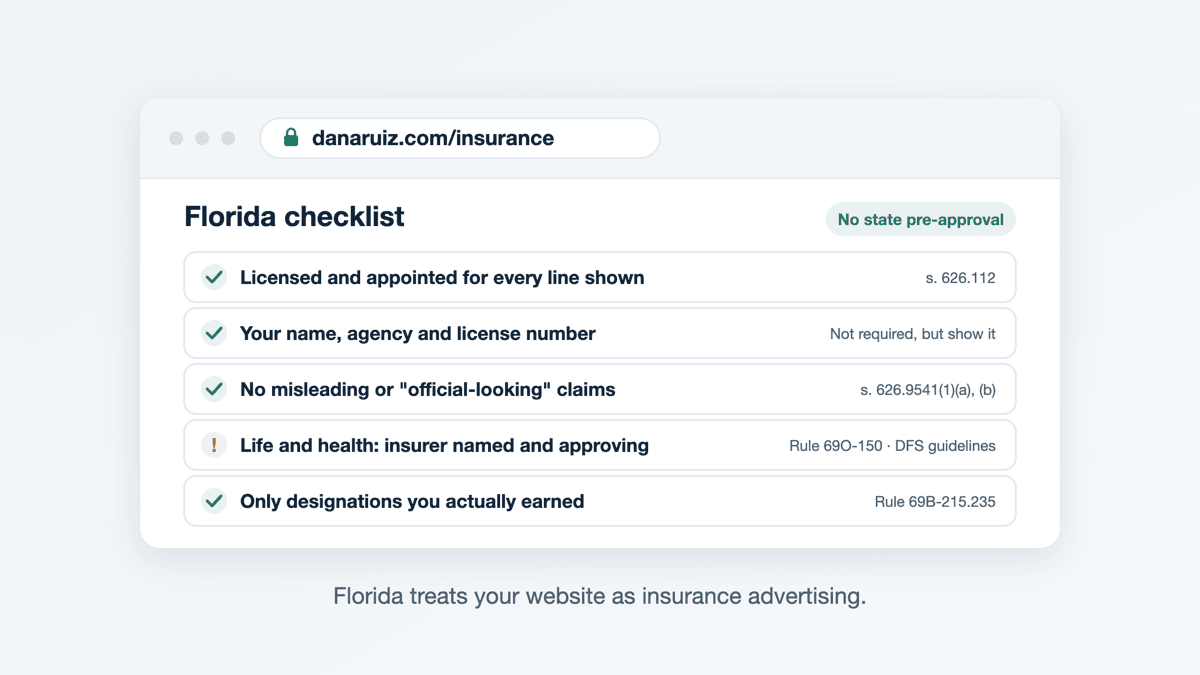
A Florida checklist for your insurance website
- You are licensed and appointed for every line the site mentions.
- Your name, agency name and license number, matching your DFS records.
- No superlatives or promises you cannot back up, and nothing that looks official or government-run.
- Life, health and annuity pages: the insurer named and the insurer's approval in writing for anything quoting features, rates or premiums.
- Only designations you have actually earned.
- Gifts or giveaways under $100 per person per year, with records.
- Any FINRA or Medicare requirements from the general compliance guide.
- A dated PDF of each version you publish.
This article explains the rules; it is not legal advice. If something on your site is a close call, ask DFS or your carrier's compliance team before it goes live.
Swift Agent Sites builds sites for Florida insurance agents: $89 a month or $890 a year with no setup fee, your own domain, hosting and https included, usually live the same day, in English, Spanish or both, with a contact form that sends leads straight to you.
Related: