Este artículo está disponible solo en inglés.
We sent 1,617 cold emails over twenty-six days, and before each one we recorded how we had obtained the address. Not whether we thought it was good — how we got it. Guessed from the company domain, read off the person's own website, taken from a regulator's filing, or inherited from a list nobody had checked.
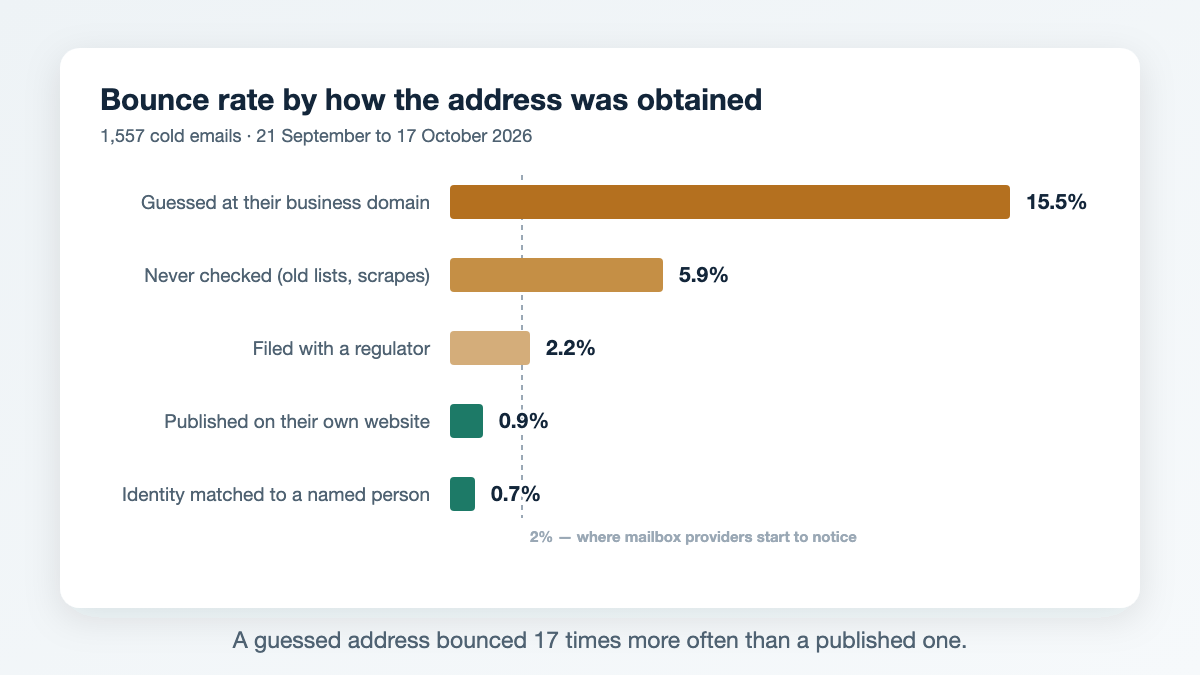
Then we counted the bounces. The spread is far wider than the advice usually suggests: an address guessed at somebody's business domain bounced seventeen times more often than one published on that person's own site.
What we measured
Every address carries a tag saying where it came from, written at the moment it was obtained rather than afterwards. That matters, because the tempting way to do this is to look at what bounced and reason backwards, which tells you nothing you did not already know.
Of the 1,617 sends, 1,557 went to addresses with exactly one sourcing tag. The other sixty went to addresses that had been found more than one way, and we left them out rather than decide arbitrarily which way counted.
The result
| How the address was obtained | Sent | Bounced | Rate |
|---|---|---|---|
| Guessed at their business domain | 110 | 17 | 15.5% |
| Never checked (old lists, scrapes) | 614 | 36 | 5.9% |
| Filed with a regulator | 135 | 3 | 2.2% |
| Published on their own website | 550 | 5 | 0.9% |
| Identity matched to a named person | 148 | 1 | 0.7% |
| All of the above | 1,557 | 62 | 4.0% |
Guessing is not slightly worse. It is in a different category from every other method, and it is the only one of the five that would get a sender into trouble on its own.
Why does a guessed address bounce so much more often?
Because guessing encodes an assumption that is usually false: that the person has a mailbox at their company's domain and that it follows the pattern you assumed. Plenty of small businesses have no mail on their domain at all — the site was built by somebody who used a Gmail address and never configured mail. Plenty more use firstname where you guessed first.last, or the owner's name where you guessed the agent's.
A published address carries none of that. Somebody typed it onto their own website because they wanted mail at it. The address exists, the mailbox exists, and the person expects to be written to. You are not inferring anything.
Is a 4% bounce rate bad?
It is higher than we would like. The commonly cited ceiling is around 2%, above which mailbox providers start treating a sender as careless, and the damage is cumulative rather than per-message: a reputation is slow to build and quick to lose. Our overall figure is 4.0%, and the table shows exactly which rows are paying for it. Two of the five methods are comfortably under 1%. The average is dragged up by the guessed addresses and the unchecked list.
Named people beat role mailboxes
A smaller finding from the same 1,617 sends, and consistent with the first:
| Who the address belongs to | Sent | Bounced | Rate |
|---|---|---|---|
| A named person | 1,516 | 58 | 3.8% |
A role mailbox (info@, hello@) | 101 | 7 | 6.9% |
Role mailboxes bounce nearly twice as often. They are also the addresses most likely to be abandoned when a business changes hands or changes provider, because nobody owns them personally and nobody notices they have stopped working.
The number we left out, and why
We track a sixth category: addresses that have already accepted an email from us. In our records it bounces at 0%, across 482 sends, which looks like the strongest row in the table.
It is not a finding, and we took it out. The tag is written because a message was delivered, so saying that delivered-to addresses do not bounce is close to saying the same thing twice. It is also not independent: 288 of those addresses are ones we had already found published on the person's own website. As an operational signal it is genuinely useful — it is the cheapest way to know an address still works. As evidence about how to source addresses, it is circular, and we would rather say so than publish a number that cannot survive being questioned.
What to do instead
The short version of everything above: find an address that is published, or do not write.
- Read their website. The contact page, the footer, the about page. This is the 0.9% row, and it is also the slowest — which is the real reason people guess.
- Check the domain accepts mail at all before you send anything to it. A domain with no MX record refuses every message sent to it, including the one on their own contact page.
- Prefer a person to a department. A named mailbox is about half as likely to be dead.
- Treat a regulator's filing as decent but not excellent. 2.2% is usable; it is also five years out of date in places.
- Do not buy the pattern-guessing tools. They sell you the 15.5% row and charge by the address.
What should you do if there is no published address?
Use the phone, or do not make contact. That is a genuinely unsatisfying answer and it is the one the numbers support. We keep a separate list of people we can only reach by phone, precisely so that nobody is tempted to guess at an address for them — because a guess does not just fail to arrive, it damages the chance that the next real message does.
A note on the sample
This is 1,617 emails sent between 21 September and 17 October 2026, from three domains, to small businesses in the United States — mostly independent real estate agents and small moving companies. It is not a large study and it is not a controlled one. It is, as far as we can tell, better than the alternative, which is that almost nobody who gives advice about cold email publishes any numbers at all.
If you want to know whether your own domain can even receive the mail people send you, our free site check will tell you in about thirty seconds.