Este artículo está disponible solo en inglés.
Short answer: ask who owns what when you leave, how long you are locked in, and who checks the marketing for compliance. The domain, the website text, your Google Business Profile and your leads should stay with you. The contract should say so in writing, before you sign it.
Most of these contracts look alike until the day you cancel. That is when you find out whether the domain is in your name, whether the pages you paid for come with you, and whether the "exclusive" leads were sold to four other agents. The questions below get you those answers while you can still walk away.
Who will own my domain, website and accounts?
Whose name will the domain be registered in?
Ask for the registrant to be you or your agency, not the vendor. The registrant is the domain's legal holder, and ICANN's registrant rights page says the registrant is entitled to the registrar's instructions for managing, renewing and transferring the name. If the vendor is the registrant, you need their cooperation to take your own web address with you.
- Best: you register the domain yourself and give the vendor access to the DNS.
- Acceptable: they register it for you, in your name, and give you the registrar login.
- Walk away: "the domain stays with us" or "we can transfer it for a fee".
Do I own the pages and articles they write for me?
Often you do not, and that surprises people. Under U.S. copyright law, text written for you by an outside company is a "work made for hire" only in narrow cases, and only with a written agreement signed by both sides that expressly says so. The U.S. Copyright Office explains this in Circular 30, Works Made for Hire. Without that, the copyright stays with whoever wrote it.
Insurance platforms often supply a library of product pages (homeowners, umbrella, commercial auto) that they license to every client. Ask plainly:
- Which pages are written for me, and which are licensed from your library?
- Can I keep the pages written for me if I cancel? Does the contract say so?
- Can I export everything, including blog posts and images, in a usable format?
Who owns my Google Business Profile and ad accounts?
Google lets a Business Profile have several users, but only one primary owner, and owners can remove other users while managers cannot. You should be the primary owner. The vendor can be a manager. The same logic applies to Google Ads, Meta ad accounts and Google Analytics: the account should be yours, with the vendor added as a user, so your history and reviews do not leave with them.
How long am I locked in?
What happens if I want to cancel after six months?
Get the answer in writing. Look in the contract for:
- Minimum term: month to month, 12 months or longer.
- Auto-renewal: whether the term renews by itself and how much notice you must give to stop it.
- Early termination: whether you owe the rest of the term, a fee, or nothing.
- What switches off: whether the site, email and call-tracking numbers go dark on the day you cancel, and how long you get to move.
A setup fee plus a long minimum term means most of the cost is paid before you know whether the service works. Ask whether a shorter term is available at a higher monthly price. Sometimes it is, and it is often the better deal.
What exactly is in the monthly fee?
Ask for a list, not a sentence. "Marketing" can mean a website, a few social posts, a monthly email, ad management (with the ad spend billed on top), or all of these. Ask what reports you get each month, and whether they show leads and calls or only impressions and clicks.
Who checks the marketing for compliance?
Insurance advertising has rules a general marketing agency may not know. Ask who reviews the content before it goes live, and who is responsible if it is wrong. Usually the answer is you, whatever the vendor says.
- Registered reps (variable annuities, variable life, mutual funds): under FINRA Rule 2210 a registered principal must approve retail communications before use. Ask whether the vendor will send drafts to your broker-dealer and wait for approval, and whether its content library is already approved by your firm.
- Medicare Advantage: if you sell plans for more than one organization, 42 CFR 422.2267 requires a standard disclaimer on your website. Ask how the vendor keeps the plan and product counts in it current each year.
- Every line: your state's advertising rules and your carrier agreements still apply. Ask whether they use carrier names and logos, and with whose permission.
We cover the rules by line of business in Does my insurance agency website need compliance approval?.
Are the leads exclusive?
How many other agents get the same lead?
"Exclusive" should mean the lead goes to you and nobody else, ever. Ask for that in the contract, along with where the leads come from (your own ads, the vendor's own websites or a resold list) and how the person agreed to be contacted. A lead who asked for "quotes" on a comparison site may have agreed to calls from a list of companies, and you may be one of several calling within the hour.
Do Medicare leads have extra rules?
Yes. Since 1 October 2024, a third-party marketing organization may share a Medicare beneficiary's personal data with another such organization only with the beneficiary's prior express written consent, given separately for each recipient. That is 42 CFR 422.2274(g)(4). If you buy Medicare leads, ask the vendor to show you the consent screen the person saw and confirm your name was on it.
What should I ask for in writing?
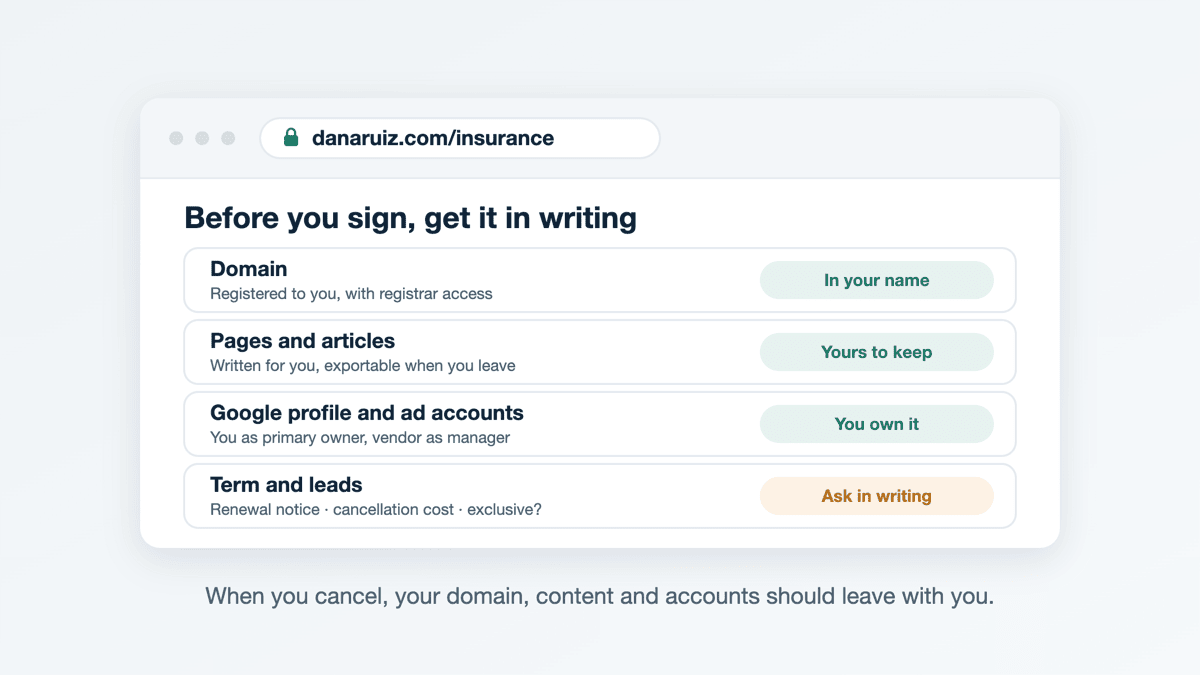
- The domain registered in your name, with registrar access.
- You as primary owner of your Google Business Profile, ad and analytics accounts.
- Which content is yours to keep, and an export of it when you leave.
- The minimum term, renewal notice and cancellation cost.
- Who reviews content for compliance, and that nothing goes live without your sign-off.
- Lead exclusivity, lead sources and proof of consent.
If a vendor will not put the answers in the contract, the answer is no.
Swift Agent Sites builds sites for insurance agents too: $89 a month or $890 a year with no setup fee and no contract, on your own domain, with hosting and https included, usually live the same day, in English, Spanish or both, with a contact form that sends leads straight to you.
Related: