Este artículo está disponible solo en inglés.
Short answer: give it something to read. An AI tool can only recommend you from what's written down, so the more of what you actually know is on the web, under your name, the more there is to return. The issue isn't views. It's how much content you have for these tools to read, and whether they come back with you as the expert.
Why should I care right now?
On October 29, 2026, Alphabet, Google's parent company, had its worst day since it began trading in 2004, losing about $480 billion in market value. Worries about its AI spending were a big part of that. But search was in the story too: Google's chief business officer told investors that the growing popularity of AI Mode, the AI tab in Google Search, took a toll on results.
Google isn't going anywhere, and its search revenue still grew 12% that quarter. But it does tell you where this is heading. The people who used to scroll a list of ten links are starting to ask one question and read one answer. If you're not in that answer, you don't get a second look further down the page, because there's no page.
Are AI tools really reading local websites?
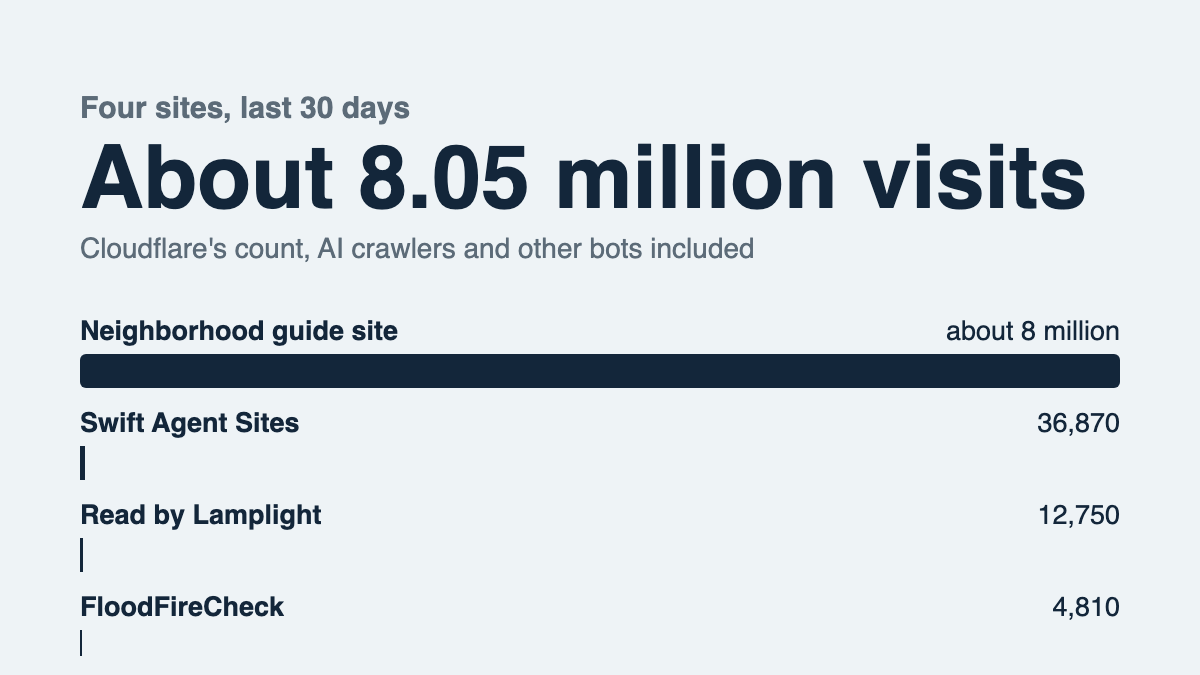
Yes, and at a scale that surprised us. We looked at four sites, and by Cloudflare's count they had about 8.05 million visits in the last 30 days, bots included. Nearly all of that is a neighborhood guide site we helped build, with pages for people deciding where to move.
On that site, crawlers from five AI companies made about 5.3 million of its 10.65 million requests in those 30 days: Anthropic, OpenAI, Meta, Apple and Amazon. Those are machines reading pages, not people, but that's the point. They read first, and they answer later.
What should I write so AI can find me?
Write down what you'd tell a friend. We haven't run a controlled test on this, so take it as what we build for rather than a proven formula. Start with these:
- The questions you get every week. One question per page, with the answer in the first two sentences.
- What only a local knows. The street you'd look at first and the one you'd warn someone about, which school run takes ten minutes and which takes forty, what floods.
- Your name and your place, spelled out. Say who you are, what you do and where you do it, in plain words on the page. An AI tool can't connect you to Davie if the page never says Davie.
- Real facts. Prices, dates, license numbers, how long things take. A general line about "charming tree-lined streets" is on a thousand other pages.
- Text that arrives with the page. Many AI crawlers don't run JavaScript, so words that only load afterward may never be read.
How much content do I need?
More than you have now, and start with one good page. There's no magic number. A page that answers one real question about one real neighborhood beats ten general ones, and you can add another next week.
How do I check whether AI can read my site?
Run our free site check. If your site runs through Cloudflare, its AI Crawl Control shows you which crawlers are reaching it. Then ask ChatGPT and Perplexity the question you'd want to be the answer to, like "who's a good agent for condos in Davie?", and see who comes back.
Does a crawl mean a customer saw me?
No. A crawl means a company read your page, and it's the step that has to happen first. Fetchers such as ChatGPT-User and Claude-User are closer to a customer, because they open a page when someone has just asked a question.
Related: