Este artículo está disponible solo en inglés.
Short answer: less than the sales pitches suggest. Google says the best practices for SEO still apply to its AI answers and that you don't need special markup or files to appear in them. What changes is the goal. SEO tries to get your page onto a list of links. AEO tries to get you named inside one answer, often on a tool that isn't Google at all. The work underneath, a readable site that answers real questions, is mostly the same.
Is AEO just SEO with a new name?
For Google's own AI features, nearly. Google's page on AI features and your website, which I read on November 5, 2026, says "The best practices for SEO remain relevant for AI features in Google Search." It also says "There are no additional requirements to appear in AI Overviews or AI Mode, nor other special optimizations necessary," and that you don't need new machine readable files, AI text files or special schema.org markup. A page has to be indexed and eligible to show in Search with a snippet.
That covers Google. ChatGPT, Perplexity and Gemini's own app each make their own choices, and no vendor has published what they weigh. So when someone sells you a secret AEO trick, ask where they got it.
What stays the same?
- A page a crawler can read. The words have to arrive with the page. Many AI crawlers don't run JavaScript.
- One real question per page, answered in the first two sentences.
- Your name, license and towns, spelled out in plain text.
- Facts that are yours: prices, dates, how long things take.
What actually changes?
| SEO | AEO | |
|---|---|---|
| The prize | A click from a list of links | Your name inside one answer |
| How you find out | Search Console shows queries, impressions and clicks | You ask the tools yourself and write down who comes back |
| Where you're read | Mostly Google | Google plus ChatGPT, Perplexity, Gemini and others |
| What wins | Pages that match a search | A name the tool can connect to one narrow subject |
The last row is the one that matters for you. A list can show ten agents. An answer names two or three. Being one more general "full-service agent" doesn't get you chosen. Being the person who wrote the clearest page on, say, condo flood insurance in one neighborhood might.
How many agents are you up against?
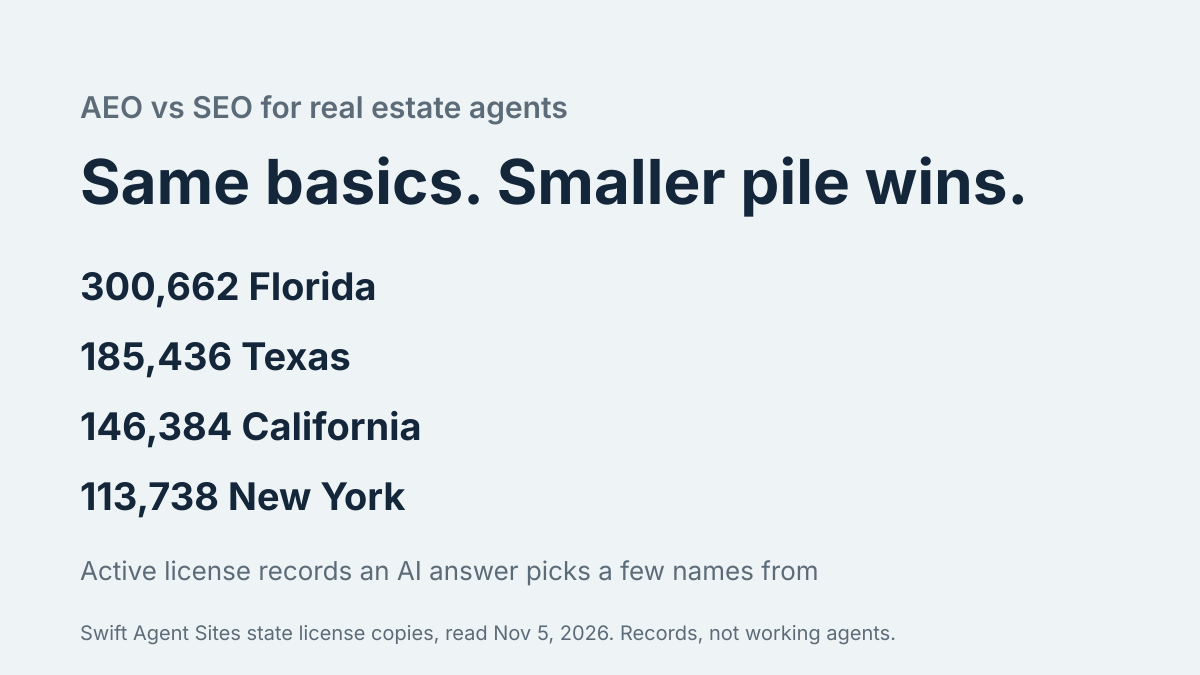
On November 5, 2026 I counted the licensees we show as active in the state license files we copy each month: 300,662 in Florida, 185,436 in Texas, 146,384 in California and 113,738 in New York. That's a count of license records, not working agents, and the files were last copied in October (Florida) and November (the others). Still, any answer has to pick a few names from a very big pile, which is why narrow beats broad. We made the same point in what AEO costs.
What should I do this week?
- Keep doing the SEO basics. Fast pages, real titles, one question per page. Google says they still count.
- Pick one narrow subject and write the page you'd want a client to read before calling you.
- Test by hand. Ask ChatGPT, Gemini and Perplexity three questions about that subject. Write down who comes back and the date. Do it again next month. Here's how we'd run it.
- Skip the tricks. Google says you don't need AI text files or special markup, so don't pay for them.
Where does Swift Agent Sites fit?
We build the site: $89 a month, with pages that put your name, license and towns in plain text. We can't promise a mention from any AI tool, and we don't track answers for you. The free site check shows what a crawler can read on your site today.
Related: