Este artículo está disponible solo en inglés.
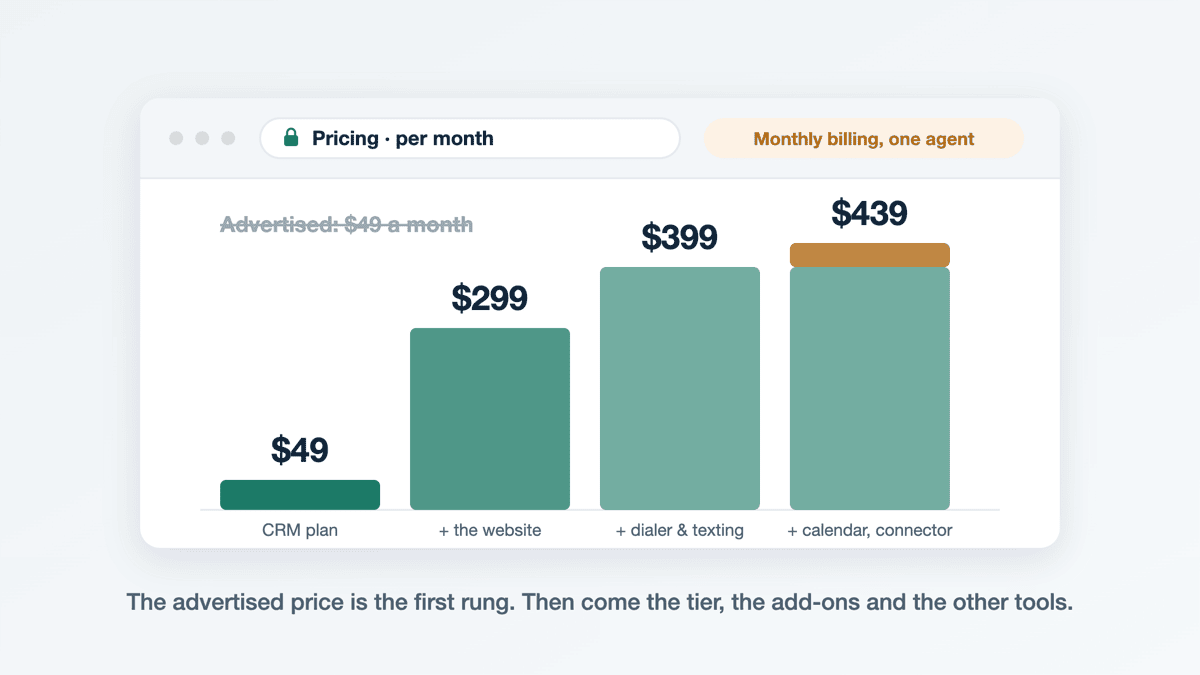
A $49 CRM rarely stays $49. The things agents actually buy it for, like a website, a dialer or texting, usually sit on a higher tier, are charged per person, or come as add-ons, and then a second and third tool get bolted on to cover what it does not do.
Short answer: the advertised price is the first rung of a ladder. Check which tier includes the features you need, multiply by everyone who will log in, add the add-ons and the tools it does not replace, and compare the monthly price, not the annual one. That is the real number.
How a cheap plan becomes an expensive one
None of this is a trick, exactly. It is how almost all software for small businesses is priced. But it adds up in the same five ways every time.
- The feature you wanted is a tier up. Entry plans cover contacts and a pipeline. A website, a dialer, texting or ads usually start one or two plans higher.
- It is priced per person. Add an assistant or a team partner and the bill doubles, even if they log in once a week.
- Add-ons. Calling, extra phone numbers and AI features are often sold separately from the plan.
- The headline is the annual price. Many pricing pages show the per-month figure you get by paying for a year up front. Pay monthly and it is higher.
- The tools do not talk to each other. A CRM that will not connect to your email tool or your calendar leads to a connector service, which is another subscription.
Two real examples
These are published prices as listed on 19 October 2026. Both are reasonable products; the point is the shape of the ladder, not the vendor.
- CloseDaily lists a CRM plan at $49 a month. Its IDX agent website first appears in the $299 plan, and a dedicated phone number, the power dialer and texting first appear in the $399 plan. An agent who came for a CRM and wants a website and a dialer is on the $399 plan.
- Follow Up Boss lists its Grow plan at $69 per user a month billed monthly, or $58 billed annually. Calling is an add-on at $39 per user a month. One agent with calling is $108 a month; an agent plus an assistant is $216. Its Pro plan, which includes calling and texting for up to 10 users, is $499 a month.
Then come the tools a CRM does not replace. Two common ones, at their own published prices: Calendly's Standard plan is $10 a seat a month, and Zapier's Professional plan, which people use to make the tools pass leads to each other, starts at $29.99 a month billed monthly. Email marketing tools usually charge by the size of your list, so that bill grows as your database does.
Add those two to the $399 plan and the agent who signed up for a $49 CRM is paying about $439 a month, before email marketing, before an assistant has a login, and paying monthly rather than a year up front.
What the bloat costs besides money
The monthly total is the part you can see. The rest shows up as time.
- Five logins and five places a lead can land. A lead that arrives in the wrong one waits until you notice it.
- The same contact in three systems, each slightly different, and none of them sure which phone number is current.
- Features you pay for and never open. A big plan is priced for the agent who uses everything on it.
- Harder to leave. The more a platform holds (your website, your contacts, your phone number), the more you have to move if you ever want to switch.
Questions agents ask
Is an all-in-one platform cheaper than separate tools?
It can be, if you use most of what is in it. One $399 plan that replaces five separate subscriptions you were really using is a good deal. The same plan bought for two of its features is not. Make the comparison against the tools you would actually pay for, not against a list of everything the platform does.
What does a new agent actually need?
Far less than the plans suggest. A website you own with a contact form that reaches you, one place to keep contacts and follow-up dates, and a way for people to book time. Several of those have free tiers to start with; Calendly, for example, has a free plan. Before buying anything, check what your brokerage already gives you, so you do not pay twice.
How do I find out what I am really paying?
Go through three months of card statements and list every subscription with its monthly cost, who uses it and when you last opened it. Note the renewal date of anything billed annually. Most agents who do this find at least one tool nobody has logged into for months.
Should I pay annually to get the lower price?
Only for a tool you are sure you will still use in a year. Annual billing is cheaper per month, but it is the whole year up front, and it is the main reason people keep paying for software they have stopped using.
The test before you sign up
Write down the three things you need it to do. Find the cheapest plan that does all three, multiply by the people who will use it, add any add-on those three things need, and use the monthly price. If that number surprises you, it is better to be surprised now than on the second invoice.
If the thing you need is a website you own, Swift Agent Sites is $89 a month or $890 a year with no setup fee: your own domain, hosting and https included, usually live the same day, in English and/or Spanish, with a contact form that sends leads straight to you.
Related: