Este artículo está disponible solo en inglés.
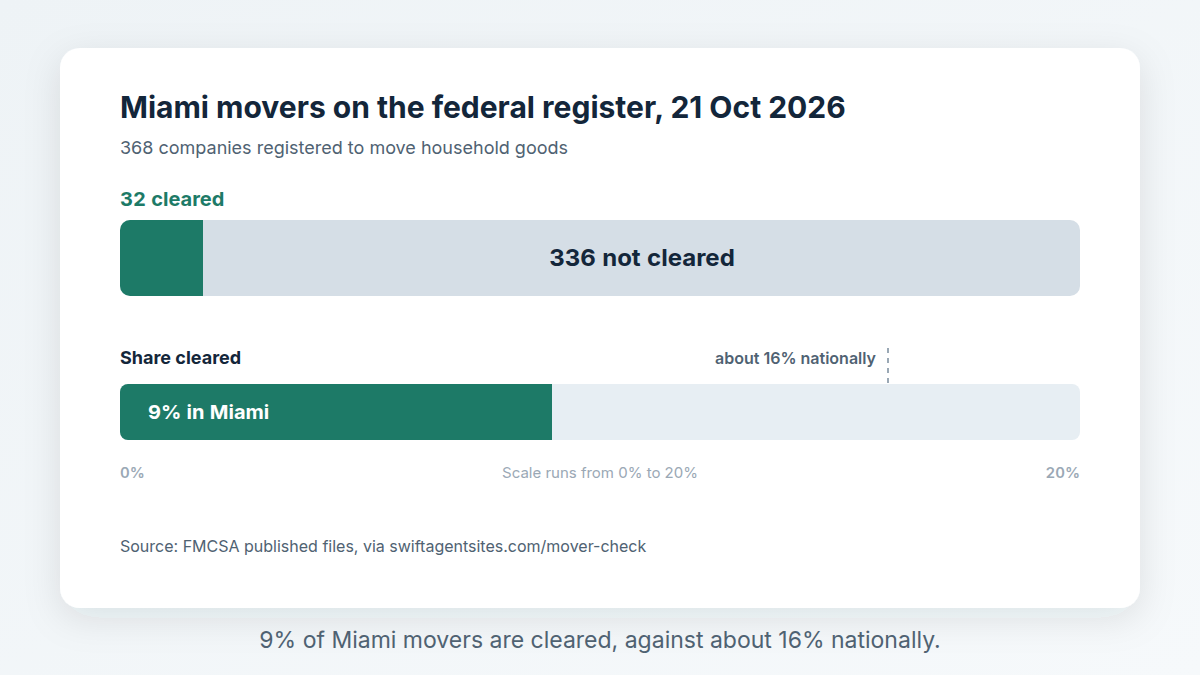
Short answer: on 21 October 2026, 32 of the 368 Miami companies registered with the federal government to move household goods were cleared to do it: active operating authority plus liability insurance on file. That is 9%, against about 16% nationally. Four more had a revocation under way. So if you pick a Miami mover off a search ad or a flyer without checking, the odds are not on your side. Checking takes about two minutes, and you can do it on our Miami mover check, which reads the federal files live.
Where the numbers come from
Every company that moves household goods across a state line has to register with the Federal Motor Carrier Safety Administration (FMCSA) and carry a USDOT number. FMCSA publishes its carrier, census, insurance and revocation registers on data.transportation.gov. Our mover check reads those files each time a page loads, and the Miami page lists every company with a Miami address that is registered to move the contents of a home.
"Cleared" on that page means two things are on file at once: active authority to carry household goods for hire, and liability insurance. It does not mean we have rated them, met them, or watched them pack a box. A filing is a filing, not a recommendation.
Here is what the Miami page showed on the morning of 21 October 2026:
| Miami movers on the federal register | Figure |
|---|---|
| Registered to move household goods | 368 |
| Cleared to operate (authority and insurance on file) | 32 |
| Share cleared | 9% (about 16% nationally) |
| Revocation under way | 4 |
| Liability cover on the cleared filings | $300,000 to $1,000,000 |
| Largest cleared fleet on file | Zorin Transports Inc, 45 trucks |
These numbers move. A company can file new insurance tomorrow, and another can lose its authority next week. That is why the page reads the files live instead of keeping a list, and why you should look on the day you book rather than trust anything you read months earlier, including this article.
Why are most Miami movers not cleared?
The register doesn't say why, and we won't guess about any one company. What a "not cleared" line usually means, in the filing itself, is one of these:
- No active authority. The company has a USDOT number but no current permission to carry goods for hire across state lines. Plenty of these are old registrations from businesses that stopped trading, changed their name, or never started.
- No insurance on file. Authority without a current liability filing isn't enough to be cleared.
- A revocation. FMCSA has revoked, or is in the process of revoking, the authority, often because insurance lapsed or a filing wasn't kept up to date.
So a low share doesn't mean 336 crooks are waiting for you. Much of the register is dead weight. But dead registrations still show up in ads and directories, and a company trading on one can't legally carry your things to another state.
How to check a Miami mover before you book
- Ask for their USDOT number. An interstate mover must have one, and it belongs on their website and paperwork. If they won't give it to you, that's your answer.
- Look it up. Put the number into the mover check, or scan the cleared list on the Miami page, where cleared companies are listed first.
- Read the whole record, not just the headline. A company page shows authority, insurance, the insurer and filing date, cargo cover, fleet size, and any past revocations. For an example of what a full record looks like, see Am Relocation Inc's page: it is cleared today, and the same page shows its history, including an earlier revocation. Both facts are worth knowing.
- Check the filing is recent. A record updated this year is a better sign than one nobody has touched since 2019.
- Ask for the insurance certificate. The register shows a filing exists. The certificate shows you the policy and its limits.
- Get estimates in writing from at least three movers. That's FMCSA's own advice in its moving checklist, along with checking the mover is registered and has a USDOT number.
Moving within Florida is a different register
This catches a lot of people. FMCSA covers moves that cross a state line. If you're moving from Orlando or Tampa to Miami, that's an intrastate move, and Florida regulates it instead.
Under Chapter 507 of the Florida Statutes, anyone doing intrastate household moves in Florida has to register with the Florida Department of Agriculture and Consumer Services (FDACS). According to FDACS, a registered mover's contracts must state its Florida registration number, its ads must show "Fla. Mover Reg. No." or "Fla. IM No.", and its trucks must display one of those on the driver's side door. FDACS also sets minimum cover, including at least $10,000 per shipment for loss or damage to household goods.
So for a move inside Florida, ask for the Florida registration number as well as, or instead of, the USDOT number. Our mover check reads the federal files only, so it won't show a Florida-only registration.
What "insured" does and doesn't cover
The liability figure on a mover's federal record ($300,000 to $1,000,000 across Miami's cleared filings) is the company's own business cover. Your belongings are covered separately, by what FMCSA calls valuation, and for an interstate move the mover must offer you two options:
- Full Value Protection. The mover repairs, replaces or pays for lost or damaged items. FMCSA says the minimum value is $6 per pound times the weight of your shipment. It costs more, and it's the default unless you sign it away.
- Released Value. No extra charge, but the mover is liable for no more than 60 cents per pound per article. FMCSA's example: a 25-pound TV would get you $15.
Two details from FMCSA's liability guide worth knowing before moving day: list anything worth more than $100 a pound (jewelry, china, antiques) on the shipping documents, or the mover can limit its liability for it, and you have nine months after delivery to file a written claim.
Questions people ask
How many movers in Miami are licensed?
On 21 October 2026, 32 of 368 Miami movers on the federal register were cleared, meaning active authority to move household goods plus liability insurance on file. The live figure is on the Miami mover check.
Does a USDOT number mean a mover is licensed?
No. A USDOT number is a registration. To move your household goods across a state line, the company also needs active operating authority and insurance on file. Plenty of Miami companies have the number without the rest.
Does a clean record mean nobody has complained?
No. FMCSA keeps a consumer complaint database that isn't open to our check, so a clean result means nothing has been filed against the registration, not that nobody has complained. Read reviews and get references too.
How much deposit should a Miami mover ask for?
We can't give you a number, because it varies by company and move. Our advice on every mover page is the same: get a written estimate, see the insurance certificate, and never pay a large deposit up front.
Is the mover check free?
Yes. It's free for anyone moving, with no sign-up. It reads FMCSA's published files and shows what is filed; Swift Agent Sites doesn't arrange moves.
Related: