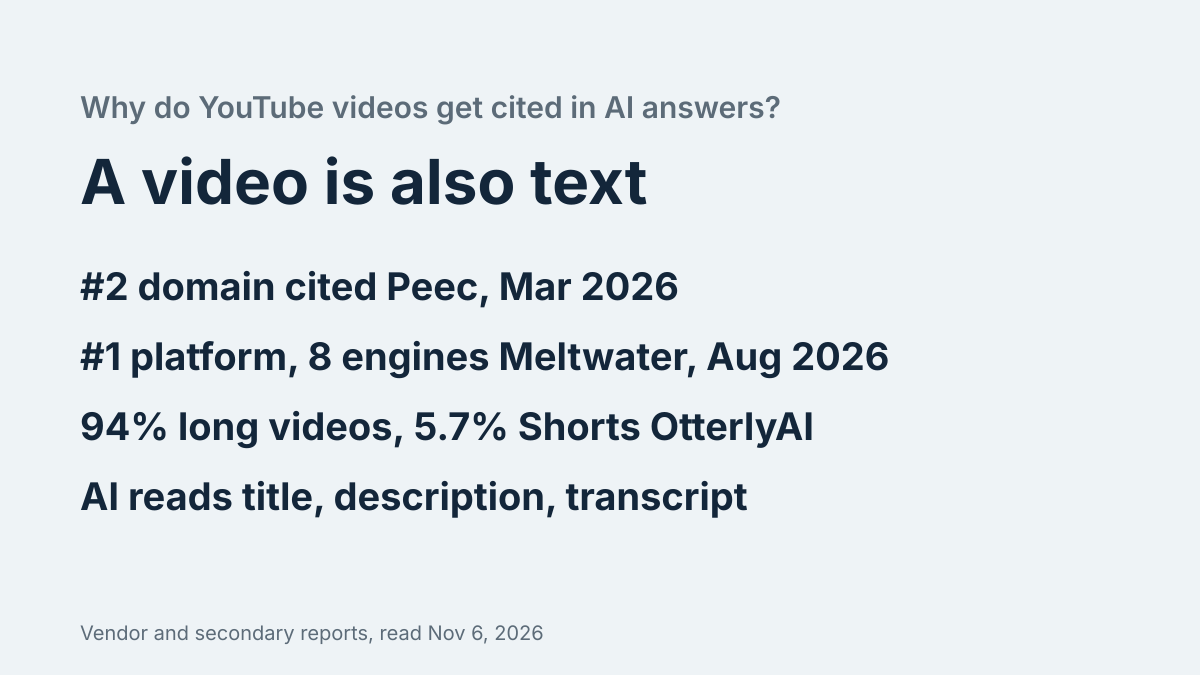
Short answer: AI tools cite YouTube because a video comes with words they can read: a title, a description and a transcript. Studies this year put YouTube at or near the top of what AI answers cite. For an agent, the video worth filming is one narrow, spoken answer to a real client question, around ten minutes or less, with the answer written out underneath. Nobody can promise that a video gets cited.
How often is YouTube cited in AI answers?
Often, though the numbers depend on who measured. Peec, which sells AI visibility tracking, analyzed 30 million sources in March 2026 and found YouTube was the second most-cited domain in AI search. A summary of Meltwater data, as reported on Relevant Audience from a Digiday article, says YouTube was the most-cited platform across eight AI answer engines in August 2026, ahead of Reddit.
Two cautions. These are tracking companies and a PR trade, not neutral labs, and I read the summary of the Meltwater data rather than the original. And a citation can be a pointer: the same summary says Claude and Gemini often embed a video as recommended viewing instead of building the answer from it.
Why would an AI tool cite a video at all?
Because a video is also text. Peec found AI draws on both the video's description and its auto-generated transcript, and in some cases Google's AI Mode built an answer from the description alone. A machine can't watch your video, but it can read what you said in it and what you wrote under it. A silent drone tour with a one-line description gives it almost nothing.
What kind of video gets cited?
The only length data I found is second-hand, so treat it as a hint. A summary of an OtterlyAI study, passed along in the same report, says 94% of YouTube citations went to long videos and 5.7% to Shorts, and that videos of 10 to 20 minutes made up 32.1% of citations. Another claim in that coverage is that view counts and subscriber counts matter little. I couldn't check that one against the study itself.
The practical reading: a small channel with a clear, long answer isn't ruled out. A pile of 30-second clips probably isn't what AI reaches for.
What should an independent agent film?
Pick the narrow thing you'd want to be known for, and film the questions people actually ask you about it. Some that fit:
- One neighborhood, answered like a friend would. "What's it like to live in Coconut Grove if you work downtown?" Say street names, commute times and what you'd warn someone about.
- One rule, explained. "What does a Florida buyer have to know about flood insurance before an offer?" One state, one question.
- One process, walked through. "What happens between accepted offer and closing in Texas?" Step by step, with real timelines.
Then do the part most agents skip. Put the question in the title, write the answer in two or three sentences at the top of the description, and add your name, license state and the towns you work in. Check the transcript for mangled street names and fix them. Embed the video on a page of your own site beside the written answer, so the same words exist in both places.
What does our own data say about the crowd you're in?
On November 6, 2026 I counted the licensees we show as active in the state license files we copy each month: 300,662 in Florida and 291,576 in California. Those are license records, not working agents. The point is the scale: an AI answer names a few people out of hundreds of thousands, and a general "meet your agent" video doesn't separate you from the rest. A specific answer does.
What doesn't a video do?
It doesn't replace your website. Your site is the place that states who you are and where you're licensed, in text that arrives with the page. One report in the coverage above, from Scrunch, found that citations to sponsored YouTube videos fell about 43% within a month, so a single video isn't a permanent asset. Plan to film another next month and test whether anything changed. Our step-by-step check shows how, and you can run the free site check on your own site today.
Related:
- What is the best AEO service for an independent real estate agent?
- How much does AEO cost for a real estate agent?
- AEO vs SEO for real estate agents: what actually changes?
- Will my website still matter in 2027?