Short answer: yes, but its job is changing. It's less likely to be where someone first finds you, and more likely to be where AI reads about you and where a person checks you out after hearing your name. Build the site for those two jobs, then add video, because AI answers cite YouTube heavily and small channels get cited too.
Why are people saying websites won't matter?
Wes McDowell, who makes videos about marketing for service businesses, put it bluntly in "Your Website Won't Matter in 2027. Prepare Now." It has about 380,000 views. His argument is that a website used to do two jobs, getting you found and building confidence, and both are moving elsewhere. People ask AI for a short list, then watch a video to see who they feel safe with. AI has also made a good-looking site so easy that it stops being a reason to pick anyone. He spent almost two decades as a web designer, and he says he still thinks you need a site, just a much smaller one. He also sells a course on getting clients from YouTube, so keep that in mind. I think the direction is right anyway, and our own numbers are moving the same way.
He gives three examples, and they're the owners' results as he tells them. I haven't checked them:
- A gutter installer in Tennessee. He made gutter guard comparisons, tests and installation tutorials, and McDowell says almost all of his business now comes through AI search.
- A gym owner in California. His channel is small, but McDowell says he closes about 70% of the calls booked by people who've watched one of his videos.
- A financial advisor. His whole channel is retirement questions for federal employees, so he never has to say who he's for.
What do AI crawlers have to do with it?
An AI tool can't name you from a page it never read. So the more of your pages it reads, the more chances you have of coming back in an answer. That's the bet I'm making across our sites, and the reading is growing fast.
On swiftagentsites.com, Cloudflare counted these requests from search and AI crawlers in October 2026. Cloudflare rounds them, and they include Googlebot and Bingbot:
| Week | Crawler requests |
|---|---|
| Oct 4-10 | 150 |
| Oct 11-17 | 300 |
| Oct 18-24 | 5,560 |
| Oct 25-31 | 10,480 |
On StrollPlace, our neighborhood site, AI crawlers made about 5.3 million successful requests in the 30 days to October 31. Those are machines reading pages. They aren't people, and I don't count them as visitors. Most of them are bulk crawlers like ClaudeBot and GPTBot, not someone asking a question at that moment. But it's the first step, and Google's own report on AI features shows our impressions rising in the same month, from about 2 a day to about 9.
Does AI cite YouTube videos?
A lot. BrightEdge gave YouTube a 29.5% citation share in Google AI Overviews and 16.6% in AI Mode, the most cited domain in both, in data from May 2024 to September 2025. Google owns YouTube, so that may not surprise you.
The most useful numbers I've found are from OtterlyAI's 2026 study of more than 100 million AI citations over 30 days. OtterlyAI sells AI visibility tracking, so it has an interest here too.
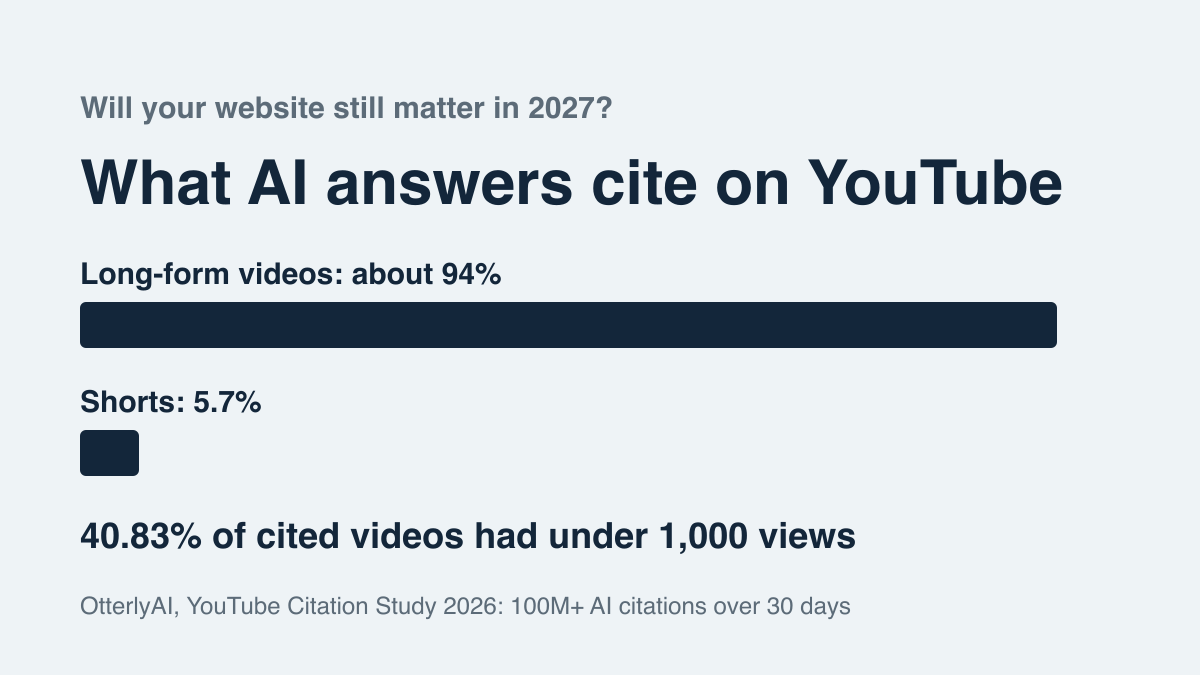
- Small channels get cited. 40.83% of cited videos had fewer than 1,000 views. Views, likes and subscribers had almost no correlation with how often a video was cited.
- Long videos get most of it. About 94% of citations went to long-form videos, mostly 5 to 20 minutes.
- Shorts get a little, mostly from Google. Shorts were 5.7% of citations, and most of those came from AI Overviews and AI Mode.
- Google and Perplexity do most of the citing. AI Overviews had 36.6% of YouTube citations, Perplexity 38.7%, AI Mode 19.6% and ChatGPT 4.4%.
- Descriptions matter a bit. Longer descriptions had a weak-to-moderate link to citations (r = 0.31), and newer videos a weak one (about 0.3). Timestamps were tied to repeat citations in Google's AI answers.
Those are correlations, and they describe videos that were cited, across every industry. Nobody has published this for real estate alone that I can find. But "you need a big audience first" is the reason most agents give for not starting, and this data doesn't back it up.
Do Shorts count?
They count for a little, and for reaching people on YouTube. We post short videos for two of our sites, and I'd keep doing that. But if the goal is being named in an answer, the numbers point to one proper 5 to 20 minute video on a real question, with a full written description.
What kind of videos should I make?
McDowell splits them into two kinds, and I think that's the most useful part of his video.
Videos that answer what people ask before they hire you, one question per video:
- Price. This is the biggest one. If it depends, explain what pushes it up and down. For an agent, that might be what it really costs to sell a condo in your building or neighborhood.
- Comparisons. One neighborhood against another, a condo against a house, or selling with an agent against selling on your own.
- Process. What actually happens after someone signs with you.
- Timelines. How long a sale really takes where you work.
- How to choose. What to ask any agent, including you, and what the red flags are.
Videos that show who you're for. Tell the stories of your right client, with their permission and with no promise that anyone else gets the same result. Let your topics make the point, so someone sees ten videos about older homes in one neighborhood and knows who you are. Mention that kind of client as you talk.
So what's my website for now?
Two things:
- It's what AI reads. Your name, license, brokerage, towns and specialties, in words that arrive with the page, and plain answers to the questions you get asked. Our free site check shows whether AI tools can read yours at all.
- It's where the deal gets started. Someone hears your name from an AI tool or a video, then looks you up. McDowell calls the site the last step now. It has to confirm you're real, show you work in their town and make it easy to reach you, and it can be much smaller than you think. Your reports may call that visit direct or branded search, so add "How did you hear about me?" to your contact form.
Is a personal brand enough?
No, I think the personal brand is dead. A nice photo, a good bio and a clever post are superficial. They work for short interactions, like a quick purchase. But a home sale can take weeks or months, and over that long people go with the person they see as the expert. So be narrow and specific, not broad and general. "I sell Miami" gives an AI tool nothing to go on. Condos in Brickell, older homes in Coral Gables or flood insurance in Kendall give it something to name you for.
The same goes for video. Don't go after views. If 20,000 people see your lifestyle video about Columbus and never plan to move to Columbus, what have you gained? Fifty views from people actually deciding on one neighborhood are worth more.
What should an agent build first?
- Pick your narrow thing. One neighborhood, one type of property or one kind of deal you can talk about for an hour without notes.
- Fix the site. Say that narrow thing plainly on the home page, with a page for each place you cover, and your license and brokerage on every page. Check what your state requires, because rules like TREC's apply to your site.
- Write down the ten questions clients actually ask. Stay inside your narrow thing. "What does it cost to sell a condo in [building or neighborhood]?" "Is [neighborhood] in a flood zone?" "What should I know before buying an older home in [neighborhood]?"
- Answer one on video each week. Say the question out loud and name the town. Five to 20 minutes on your phone is fine. Your brokerage's and your state's advertising rules apply to video too.
- Write a real description. The question, the answer in a few sentences, timestamps, your name and town, and a link to the matching page on your site. The videos in OtterlyAI's study averaged 334 words.
- Put the video on the matching page. The site and the channel then point at each other.
- Test every month. Ask ChatGPT, Perplexity and Google AI Mode the same questions and write down who comes back. Nobody can promise you a mention, us included, so keep score yourself.
Where does Swift Agent Sites fit?
We build the site part: pages AI tools and search engines can read, with your name, license and towns spelled out. That won't guarantee you get named, and it won't make the videos for you. Ask for a free preview if you'd like to see yours.
Related:
- Is AEO a real alternative to Google Ads?
- Why doesn't AI name you yet?
- What is AEO, and why should real estate agents care?