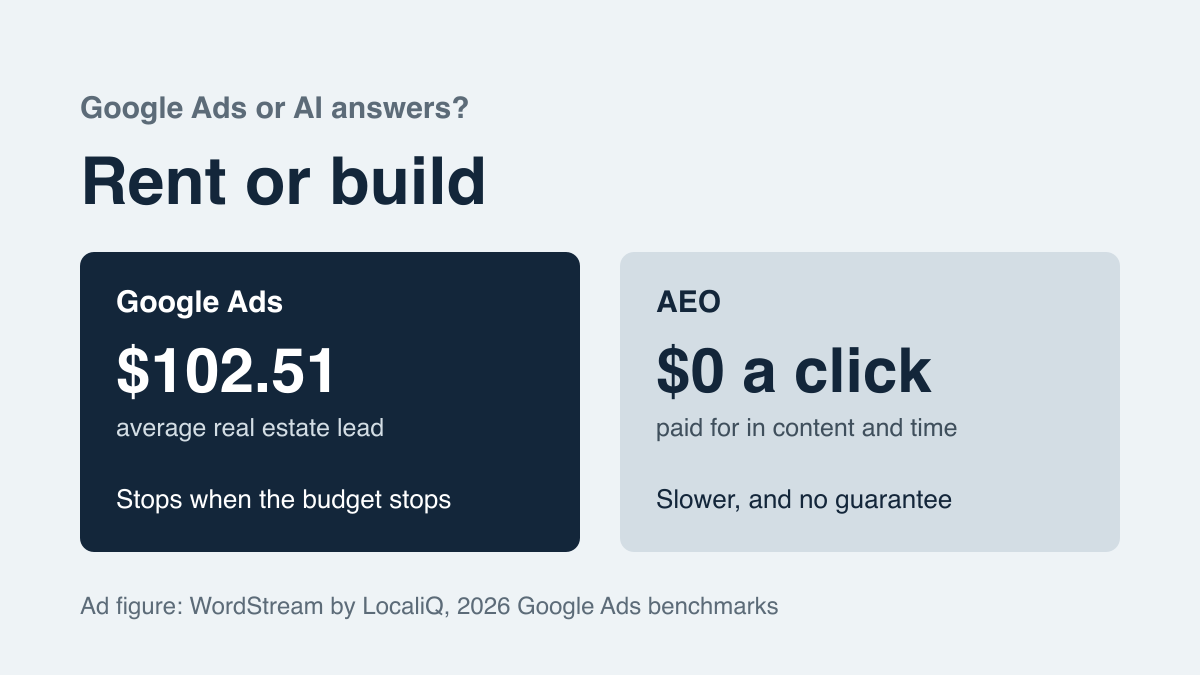
Short answer: partly, and not yet for anything urgent. With Google Ads you rent visibility, and it stops the day you stop paying. With answer engine optimization (AEO), you write the pages AI tools read, so they can name you when someone asks who to call. There's no charge per click, but it's slower, you can't control the wording and nobody can promise you a mention. Most independent agents should build on AEO and keep ads for short, urgent pushes.
What does a Google Ads lead cost?
WordStream's 2026 benchmarks looked at more than 13,000 search campaigns from April 2025 through March 2026. In real estate, ads were clicked 7.61% of the times they showed, which is their click-through rate. The average click cost $3.22, up 27% in a year, and the average lead cost $102.51. That's the third highest of 23 industries. In finance and insurance, the click-through rate was 9.83% and clicks averaged $3.39.
Those are averages, and your market may run higher or lower. They also count leads, not clients. Ads are still a good product: they start within days, you choose the words and you can measure them down to the click. But the money is rent. When the budget ends, so does the visibility.
Fewer searches end in a click at all. SparkToro and Similarweb report that 68% of US Google searches ended without a click in the first four months of 2026, and Ahrefs found that an AI Overview cuts the top result's click-through rate by 58%. Those figures are about ordinary results, not ads, but they show why being named in the answer matters.
How do ads and AEO compare?
| Google Ads | AEO | |
|---|---|---|
| Speed | Days | Months, with no set date |
| Cost | Every click, every day | Your time or a writer's, and a site that can be read |
| Who writes what people see | You | The AI tool |
| Measurement | To the click | Mostly asking the tools and writing down the answer |
| If you stop | It ends that day | The pages stay up, though answers can still change |
| Guarantee | You get the clicks you pay for | None |
Is there proof that AEO works?
There's a direction, not proof. Duda studied 858,457 sites on its platform and found that sites AI crawlers visited had about 3.2 times the human traffic and 2.7 times the form completions of sites they skipped. That doesn't show the crawlers caused it, because busy sites with more content get crawled more anyway.
The same study shows what the crawled sites had in common. About 93% of sites synced with a Google Business Profile got crawled, against 59% without one. For sites with local schema, it was 72% against 55%. Sites with 50 or more blog posts averaged about 1,374 crawler visits, against about 42 for sites with no blog.
On closing, a study reported by HousingWire put AI-sourced real estate leads at a 9.6% close rate within 90 days, against 2.4% on Zillow Premier. The numbers come from FlyDragon, an AI visibility company that tracks these leads through to closing. Ad platforms have little reason to publish a comparison like this, so the people measuring it are mostly the ones working on AI search.
Does AI name Swift Agent Sites?
Sometimes, and more often than it did a month ago. Google Search Console now has a report on generative AI features in Search. It counted 171 impressions for swiftagentsites.com in October 2026: about 2 a day in the first ten days and about 9 a day in the last twelve. None of those were bought. The pages shown most are plain answers to questions agents ask, such as what TREC requires on a Texas agent's website and whether an insurance agency's website needs compliance approval.
It's still small, and it's one month. The report doesn't show which questions triggered those impressions, and an impression doesn't mean anyone read our name. When I asked Google three broader questions on November 1, such as "I'm an insurance agent and need help with digital marketing, what companies should I look at?", we didn't come up. That was one signed-out browser on one day, and answers change. But it suggests we appear for specific questions and not yet for "who should I hire?"
Why did those impressions rise?
My best explanation is that Google read more of the site and then showed more of it. Googlebot went from at most 50 requests a day to more than 1,900 on October 20 and again on October 21. Regular Search impressions went from about 44 a day to about 193, and the AI impressions moved with them almost day for day. That timing doesn't prove the crawling caused it. This is also Google's report, so it says nothing about ChatGPT or Perplexity.
It can also start quickly. We launched another site, FloodFireCheck, on October 21. The same report showed its first AI impression on October 25, four days later, and 7 by the end of the month. That's too early to read much into, but it's interesting.
Does bot traffic mean AI tools are reading me?
Often not, so check which bots you're actually getting. Cloudflare counted about 221,000 page views on swiftagentsites.com in October from outside Mexico, where I work. Here's what they were:
- 34% were SEO tools like Ahrefs and Semrush. They don't put you in front of anyone.
- 25% were other scripts and scrapers.
- 29% looked like browsers. That includes real people, and also a crawler that hit us on October 20.
- About 7% were search and AI crawlers: Perplexity 6,060, Apple 4,650, Google 4,300, Anthropic 480, Bing 400 and OpenAI 150.
Even that 7% is a machine reading a page, not a person seeing your name. On one of our other sites, Read by Lamplight, about 25% of the same count is search and AI crawlers, so the mix really does differ from site to site.
Which AI crawlers should I let in?
Know the difference first. Training crawlers such as GPTBot and ClaudeBot collect text to train models. Search and fetch crawlers such as OAI-SearchBot, ChatGPT-User and PerplexityBot read pages to answer people. Our own robots.txt, managed through Cloudflare, tells the training crawlers to stay out and lets the others in. I found that while writing this. Whether blocking training crawlers changes who gets named isn't settled, but you should know which choice your site has made.
Why won't my analytics show AEO working?
Because the visit may not come from the AI tool. Someone sees your name in an answer, then looks you up on Facebook, LinkedIn or YouTube, types it into Google a day later or goes straight to your site. Your reports call that social, branded search or direct traffic, the way they've always hidden word of mouth.
That cuts both ways. Low clicks don't prove AEO isn't working, and a busy direct channel doesn't prove it is, because your emails, posts and referrals land in the same place. We can't measure how often that path happens, and neither can anyone selling you AEO.
The simplest way to find out is to ask. Add one question to your contact form: "How did you hear about me?"
What should I do this month?
- Let the right crawlers in. Read your robots.txt and, if you use Cloudflare, its AI Crawl Control. Our free site check shows whether AI tools can read your site at all. In Search Console, look under Settings for "Search generative AI" and make sure your site isn't excluded.
- Answer buyer questions in plain language. One question per page, with the answer in the first two sentences. Say your name, your license and your town.
- Get mentioned on other sites. In my test, Google cited an Insurance Business top 10 list and a Reddit thread. Local press, associations and trade lists are all worth your time.
- Test every month. Ask ChatGPT, Perplexity and Google AI Mode the same five questions your prospects ask, and write down who comes back. If you use Search Console, look for its Generative AI report under Performance. It's in beta, so you may not have it yet.
- Keep ads for short pushes. A new office, a new town, open enrollment, or a month when you need calls this week.
Which five questions should I test?
Use the words your prospects use, and fill in your own town. Here's a start:
- "Who's a good real estate agent for condos in [town]?" or "Who's an independent insurance agent in [town] who handles flood?"
- "What should I ask before hiring one?"
- "Is [your name] a good agent?"
- "What does it cost to sell a home in [town]?" or "What does flood insurance cost in [town]?"
- The question you hear most often from new clients.
How should I split the money?
Pay for the foundation first, then rent when you need speed. To give you a sense of scale, our Agent Website plan is $890 a year, and at WordStream's average that buys eight or nine real estate leads from Google Ads. A website doesn't guarantee you a single lead, so that isn't a like-for-like comparison. If an ad campaign is profitable for you now, don't turn it off to test this. Start the pages alongside it.
Where does Swift Agent Sites fit?
We build sites for independent agents that AI tools and search engines can read: the words arrive with the page, your name and your area are spelled out, and the structured data says what you do. None of that guarantees a mention. It removes the obvious reasons you couldn't get one. Ask for a free preview if you'd like to see yours.
Related:
- What is AEO, and why should real estate agents care?
- Why can't ChatGPT find my insurance agency?
- Why doesn't AI name you yet?