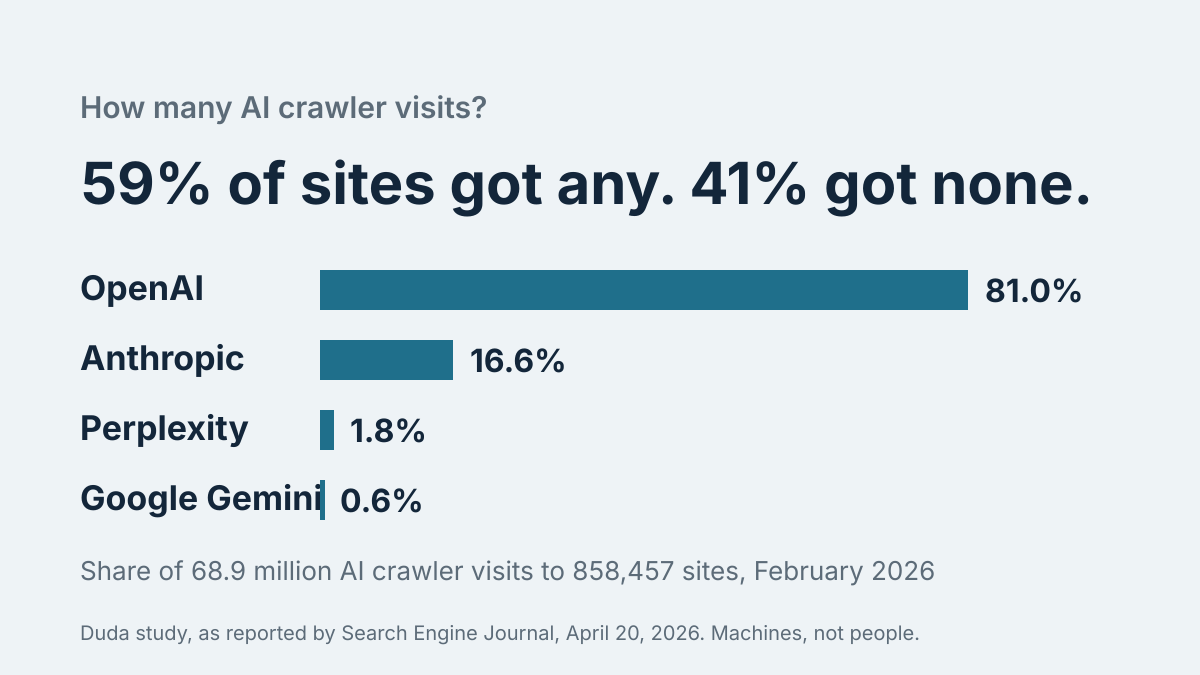
Short answer: nobody has published a number you should hit, and I wouldn't trust one if they had. The best data I've found says 59% of sites got at least one AI crawler visit in a month, and 41% got none. So the first goal isn't a big count. It's more than zero, on the pages that answer your clients' questions. Crawler visits are machines reading your pages. They aren't people, and they aren't leads.
What did Duda find?
Duda, a website platform, analyzed 858,457 sites on its own platform for February 2026. Search Engine Journal's write-up (April 20, 2026, read today) gives these totals. Duda sells websites, so it has an interest in sites looking worth building.
- 68.9 million AI crawler visits in the month.
- 506,910 sites (59%) had at least one visit. The other 41% had none.
- By company: OpenAI 81.0%, Anthropic (Claude) 16.6%, Perplexity 1.8%, Google's Gemini 0.6%.
- By purpose: 56.9% were a tool fetching a page because a person asked a question, 28.8% were collecting pages for training and 14.3% were discovery.
The article doesn't give an average per site, so I can't tell you what a typical site gets. The only averages it gives are for groups, and the study doesn't claim any of this is cause and effect.
What did the crawled sites have in common?
- Google Business Profile synced: 92.8% were crawled, against 58.9% without.
- Local schema: 72.3% against 55.2%. Sites with 10 or 11 completed fields reached 82%.
- Reviews integrated: 89.8% against 58.8%.
- 50 or more blog posts: about 1,374 crawler visits on average, against about 42 for sites with no blog.
- Online stores were the one group crawled less (54.2% against 59.2%).
Duda also found that crawled sites averaged 527.7 human sessions against 164.9 for sites that weren't, about 3.2 times. I wouldn't read that as crawlers sending visitors. Busy sites with more content and more local detail get crawled more anyway, which is the same direction the list above points.
What does a small real estate site actually see?
Here's our own reading, so you can see how lumpy it is. Cloudflare counted these requests from search and AI crawlers to swiftagentsites.com in October 2026. Cloudflare rounds them, and they include Googlebot and Bingbot, so it's not an AI-only count:
| Week | Crawler requests |
|---|---|
| Oct 4-10 | 150 |
| Oct 11-17 | 300 |
| Oct 18-24 | 5,560 |
| Oct 25-31 | 10,480 |
That's a site with a few hundred pages that kept adding more, and it went from about 150 requests a week to more than 10,000 in four weeks. I first published these figures on November 1, and I haven't pulled a newer set for this article. Your count will depend on how many pages you have and how much new content you add, not on a target.
Where do I find my own count?
- Cloudflare, if your site uses it: look at the analytics for requests by user agent or bot. Names to look for are GPTBot, OAI-SearchBot, ChatGPT-User, ClaudeBot, PerplexityBot and Googlebot.
- Your host's server logs, if they offer them. Search the log for the same names.
- A site builder dashboard may show none of this. If yours doesn't, ask the company whether it can, and don't assume zero.
Google Analytics won't show crawlers, because they don't run the tracking script. A user agent name can also be faked, so treat any count as approximate.
What should I do if the number is zero?
- Check the basics aren't blocking it. Open yourdomain.com/robots.txt and make sure it doesn't disallow the AI crawlers above. Some hosts block them by default.
- Make sure the words arrive with the page. If your content is added by JavaScript, many AI crawlers won't see it. Our free site check shows what a crawler gets.
- Put your name, license, brokerage and towns in plain text, on every page.
- Add pages that answer one narrow question each. That's the part of Duda's list that's actually in your hands: more real content, and local details filled in.
- Re-check in a month and write the number down with the date.
Does a higher number mean AI will name me?
No. A crawler visit means a machine fetched a page. It doesn't mean any tool will recommend you, and nobody can promise that, us included. The only test is to ask. Our guide to checking whether ChatGPT, Gemini and Perplexity recommend you takes about 20 minutes.
Where does Swift Agent Sites fit?
We build the site part: pages that arrive as finished text, with your name, license and towns spelled out. It's $890 a year. That doesn't guarantee crawler visits or mentions. Ask for a free preview if you'd like to see yours.
Related:
- AEO vs SEO for real estate agents: what actually changes?
- How much does AEO cost for a real estate agent?
- What is the best AEO service for an independent real estate agent?
- Why do YouTube videos get cited in AI answers?