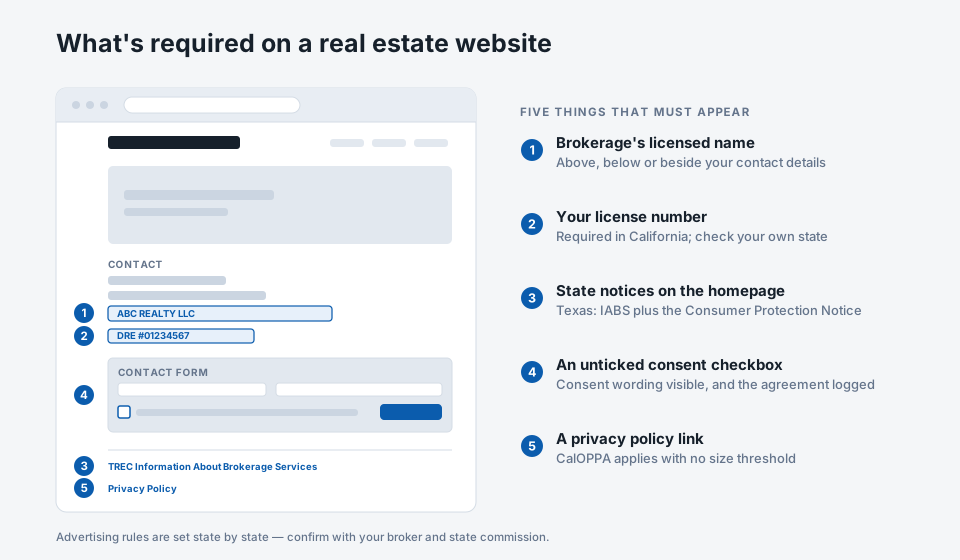
A real estate agent's website legally has to show your brokerage's licensed name, usually beside your contact details, and your own name as it is registered with the state; some states add more, such as your 8-digit license number in California and two linked notices on the homepage in Texas. On top of state license law, four rules apply to almost every agent site: Fair Housing in your copy, TCPA consent on your lead form, CAN-SPAM in the email that follows, and a privacy policy, because California's CalOPPA has no size threshold at all.
Two things get oversold: the Equal Housing Opportunity logo is not a blanket federal requirement, and a solo agent almost never needs a full CCPA compliance program. What actually causes trouble is a missing brokerage name, careless neighborhood copy, and a lead form that cannot prove consent.
This is a plain-English summary, not legal advice. Rules are set state by state, and your brokerage may be stricter. Every rule, date and dollar figure below was checked against the sources at the end on November 10, 2026.
State license law: the part that gets agents fined
This layer is entirely state-specific. Three big markets show the range.
Florida
Under Florida Administrative Code rule 61J2-10.025(3)(a), the brokerage's licensed name must appear above, below, or adjacent to the point of contact information — and "point of contact" is broad: mailing address, physical address, email, phone, cell, or fax. A footer listing your phone number but not your brokerage is a violation.
- Your last name must appear as registered with the Florida Real Estate Commission.
- Nicknames go in quotation marks — John "Johnny" Johnson (61J2-10.025(2)).
- Under 61J2-10.026, a team name cannot be displayed larger than the brokerage name, which matters for the hero section of a team site.
More on Florida's rules, including team sites: What does Florida require on a Florida real estate agent's website?
Texas
Texas is the strictest of the three. Under TREC Rule 531.20(b), every broker and sales agent must link from their homepage to the Information About Brokerage Services (IABS) notice and the TREC Consumer Protection Notice. Link text and font size are prescribed:
- "Texas Real Estate Commission Information About Brokerage Services" at 10-point minimum, or "TREC Information About Brokerage Services" at 12-point minimum. The same two options apply to the Consumer Protection Notice.
- Both must sit in a readily noticeable place on the homepage. A footer is generally accepted; an interior page is not.
- If a social profile is your business website, the link can live on the profile or one direct click away.
The Texas rules go further than the two links, into team names, titles and your broker's name at half your size: What does TREC require on a Texas agent's website?
California
Business and Professions Code section 10140.6(b) requires licensees to disclose their license number on all solicitation materials intended to be the first point of contact with consumers. The DRE's regulation 2773 lists websites you own, control or maintain among those materials, and asks for your eight-digit license number and your responsible broker's name as currently licensed (the broker's own number is optional). The number must be no smaller than the smallest type used elsewhere, so a license number in 8px gray under 16px body text is not compliant.
Everywhere else
Do not assume your state matches these. Check your commission's rule for four things: whether the brokerage's licensed name is required and where it sits, whether your license number must appear and at what size, whether a state notice must be linked from the homepage, and whether team names are size-restricted. Our guide to what an agent website should include covers the pages themselves.
Do you have to put the Equal Housing Opportunity logo on your site?
Usually not as a matter of federal law, despite how often it is repeated as a hard rule. HUD's guidance says advertisements should carry the Equal Housing Opportunity logo or statement — but "should" is not "must," and no federal mandate attaches it to every marketing piece. NAR has not adopted a logo rule either; the change effective January 1, 2025 was an education requirement, two hours of fair housing training every three years. Put it in your footer anyway: it costs nothing, and some state commissions, MLSs, and brokerages require it by their own rules.
The real exposure is the copy, not the logo. The Fair Housing Act reaches statements indicating a preference or limitation based on a protected class:
- Do not describe a neighborhood by the demographics of the people in it.
- Avoid "perfect for families," "ideal for young professionals," "safe neighborhood," or proximity to a named house of worship as a selling point.
- Describe the property, not the buyer you imagine for it.
What do the rules say about your lead capture form?
This changed in 2025, and much of the advice online still describes the old world. The FCC's "one-to-one consent" rule — which would have forced lead forms to collect consent one named seller at a time — was vacated on January 24, 2025 by the Eleventh Circuit in Insurance Marketing Coalition v. FCC (No. 24-10277), which held the FCC exceeded its statutory authority. It never took effect, so the per-seller checkbox the industry spent 2024 preparing for is not currently required. What applies is the statute: to give prior express consent, a person need only "clearly and unmistakably" state beforehand that they are willing to receive the call. The FCC's revocation rules did take effect, on April 11, 2025:
- Consent can be revoked by any reasonable means — stop, quit, revoke, opt out, cancel, unsubscribe, end — in the language the message was sent in.
- You must honor it within 10 business days, down from 30.
- One confirmation message is allowed within five minutes, with no promotional content.
- The burden is on you to show a revocation was unreasonable, not on the consumer to show it was valid.
- The broader "revoke-all" provision has not taken effect. The FCC delayed it to January 31, 2027 (order of January 6, 2026), then voted in September 2026 to narrow it: an opt-out from a marketing call or text ends all of that caller's marketing calls and texts, effective 30 days after the change is published in the Federal Register. Nearly every text an agent sends a lead is marketing, so treat one "stop" as stopping them all.
For a solo agent's contact form: a checkbox that is not pre-ticked, consent language visible next to the submit button rather than buried in linked terms, and a stored record of the timestamp, IP address, and exact wording agreed to. Most agents find the gap only when a lead disputes a call. Our post on how new agents get their first leads online covers what to do once the form is right.
Does a solo agent website need a privacy policy?
In practice, yes — and the reason is not CCPA. California's Online Privacy Protection Act applies to any commercial website collecting personally identifiable information from a California resident. There is no revenue or headcount threshold, and it reaches operators outside the state. If a Californian can fill out your contact form, it reaches you.
The policy must be conspicuously posted — on the homepage, or behind a link using the word "privacy" set off by color, capitals, or other distinguishing formatting — and must state:
- The categories of personally identifiable information you collect, and the categories of third parties you share it with — for most agents, your CRM, email platform, and brokerage.
- How a visitor can review and request changes to their information.
- How you will notify visitors of material changes, and the policy's effective date.
- How you respond to Do Not Track signals, and whether third parties track visitors across sites (AB 370).
Broader regimes like the CCPA kick in at revenue or record-count thresholds an individual agent will not reach. You need an accurate privacy policy, not a compliance program.
The email you send afterwards
Commercial email to leads falls under CAN-SPAM. The requirements are short: accurate "from," "reply-to," and routing information with a subject line that matches the content; a valid physical postal address, PO box acceptable; a working opt-out honored within 10 business days at no cost; and identification as an advertisement where that is not obvious. Penalties are assessed per email, not per campaign: up to $53,088 for each email in violation, the figure in the FTC's CAN-SPAM compliance guide on November 10, 2026. It was $40,000 when inflation indexing began in 2016.
Can you get sued over website accessibility?
It is a growing category, though agents are not the main target. By Seyfarth Shaw's count of federal court filings, website accessibility suits reached 3,117 in 2025, up 27% from 2,452 in 2024 — New York led with 1,021 and Florida nearly doubled to 961, while California recorded only four, after state court decisions held online-only businesses are not covered there. The law is unsettled and most suits target retail, but the mitigations are cheap:
- Alt text on listing photos and your headshot.
- Text contrast meeting WCAG AA, roughly 4.5:1 for body text.
- Every form field with a real associated label, not just placeholder text.
- Keyboard navigation with a visible focus indicator, and headings used in order as structure rather than chosen for font size.
An overlay widget bolted on at the end is not a substitute for markup that was accessible to begin with.
What is not required?
- An IDX or MLS feed. No law requires one, and for most solo agents the cost outweighs the return — see why adding MLS listings usually isn't worth it. Run IDX and your MLS's display rules become a fifth layer.
- A branded domain, legally speaking — though owning it yourself matters because it survives a brokerage change. See using your own domain name.
None of it moves the budget. Compliance is markup and copy, not a product tier, so our breakdown of what agent websites cost holds either way.
Frequently asked questions
Do I have to show my license number on my website?
It depends on your state. California expressly requires it under B&P Code 10140.6(b); many states require the brokerage's licensed name but not your individual number. Check your commission's rule rather than copying another agent's footer.
What happens if my website breaks these rules?
It depends on which rule. State license rules are enforced by your real estate commission against your license, with fines set state by state (Texas's ranges are in our TREC guide). A CAN-SPAM violation can cost up to $53,088 per email. Under the TCPA, a person can sue for $500 per unwanted call or text, and a court can triple that if the violation was willful or knowing.
How can I check my own website?
Open your homepage on a phone and look for four things: your brokerage's licensed name next to every phone number and email, your name exactly as the state lists it, any notice or license number your state requires, and a privacy link near the contact form. Our free agent license lookup shows your name and license as Texas, Florida, California and six other states list them. Our free website checker covers the technical side (SPF and DMARC for the email your form sends, domain expiry, heavy images), but it does not judge legal compliance. Insurance agents have their own rules: see the insurance website check.
Do I still need one-to-one consent on my lead form?
No. The FCC's one-to-one consent rule was vacated by the Eleventh Circuit on January 24, 2025 and never took effect. You still need genuine prior express consent — a clear, unticked checkbox and a stored record of it.
How fast do I have to honor an opt-out?
Within 10 business days, for both TCPA revocations (since April 11, 2025) and CAN-SPAM email opt-outs. For calls and texts, any reasonable wording counts, not just "STOP."
Is compliance my responsibility or my brokerage's?
Both, and the licensee is usually named. State advertising rules apply to sales agents directly, and most brokerages add policy on top — logo use, approved brokerage name formats, site review before launch. Ask your broker for the written policy before you build.
Getting it right from the start
None of this is difficult — a footer, a consent checkbox, a privacy page, and care in how you describe neighborhoods. It is just easy to miss when building a site yourself.
Swift Agent Sites builds agent websites with the brokerage line, license number, required state notices, consent-ready lead forms, and a privacy policy in place from the first draft, for $890 a year with no setup fee. You can request a free preview site, built with your name, market, and bio and emailed to you within three business days. No payment details, no obligation.
Sources
- Florida Realtors — Florida Advertising Laws for Realtors and Real Estate Agents (rule 61J2-10.025)
- Texas Real Estate Commission — Tips for Posting the IABS and Consumer Protection Notice
- Texas Real Estate Commission — Flexibility Added for Posting a Link to IABS and Consumer Protection Notices
- California Department of Real Estate — License Disclosure Requirements (RE 858)
- Wiley — Eleventh Circuit Vacates FCC's One-to-One TCPA Consent Rule
- Consumer Financial Services Law Monitor — FCC Further Extends Effective Date for TCPA Revoke-All Rule (January 2026)
- Hunton — FCC Adopts Clarifying Changes to the TCPA Revoke All Rule (September 2026)
- 47 U.S.C. § 227 (TCPA), damages in subsection (b)(3)
- Federal Trade Commission — CAN-SPAM Act: A Compliance Guide for Business
- Nixon Peabody — FCC Partially Delays New TCPA Consent Revocation Rules
- Seyfarth ADA Title III — Federal Court Website Accessibility Lawsuit Filings Bounce Back in 2025
- Greater Albuquerque Association of Realtors — Myth vs. Fact on the Fair Housing Logo
- Consumer Federation of California — The California Online Privacy Protection Act (CalOPPA)
- WilmerHale — FTC Civil Penalty Inflation Adjustments
- National Association of Realtors — When Does a Realtor Use the Equal Opportunity Logo?