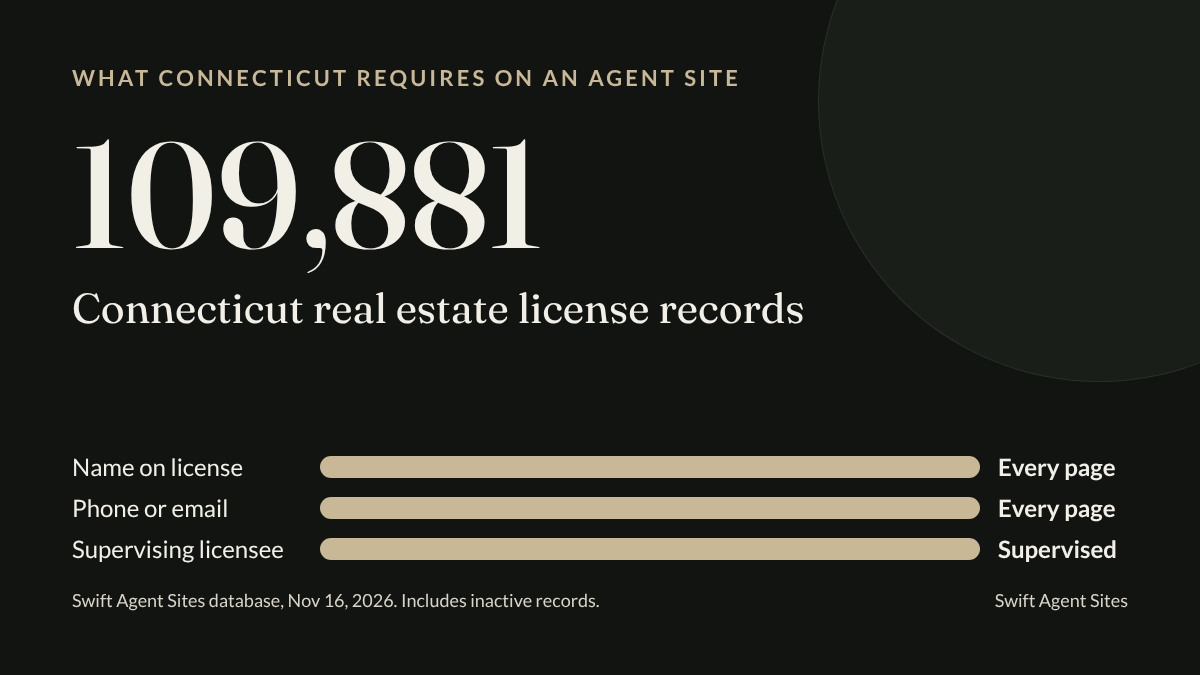
Short answer: On each page, your name as it appears on your license, shown prominently, plus a phone number or email. If you're an associate broker or salesperson, your supervising licensee's name goes on every page too. And unless your MLS updates it automatically, the last date your property information was revised.
That's from the Connecticut Department of Consumer Protection's page 2024 Changes to Real Estate Advertising, which I read on 16 November 2026. One limit on what I can tell you: that page doesn't cite a regulation number, and the official text of the regulations wasn't available to me today, so I can't quote you a section. The page does cite Sec. 20-311(1) of the Connecticut General Statutes for what counts as advertising. This is a plain-English summary, not legal advice. Confirm the exact wording with the Department before you publish.
What has to be on each page of the site?
The Department separates supervising licensees (brokers) from supervised ones (associate brokers and salespeople). For internet sites, it says to prominently display on each webpage:
- If you're a supervising licensee: your name as it appears on your license, a phone number or email, and the last date property information was revised, unless your MLS updates it automatically.
- If you're supervised: your name as it appears on your license (or a nickname the Department has approved), a phone number or email, and the same revision date. Each page also carries your supervising licensee's name and a phone number or email, in at least the same font size as your own name.
- If you run the site with another licensee: both licensees' names, phone numbers and emails.
"Each webpage" is the part to take literally. Putting it in the footer template, not just on the home page, is the simple way to meet it.
Does Connecticut require my license number?
Not on the Department's advertising page. It asks for the name as it appears on your license and doesn't list a number. I can't tell you whether another rule asks for one, so confirm that with the Department. Showing your number anyway is still useful: it's the fact that lets a person, or an AI tool, match you to the state's public record.
What about social media, apps, texts and email?
The Department calls these electronic media. It says to prominently display your name as it appears on your license and to include a link to an internet site that meets the requirements above. Supervised licensees show their name (or approved nickname) and link to a compliant site. So a social profile or email signature with your name and a link to your site, which then carries the full set, covers the plain case. Whether the supervising licensee's name has to show in the post itself isn't spelled out in the summary I read, so ask.
What about team names?
A team has to be registered to call itself a team, and it can't present itself as a business entity. A group that isn't registered as a team can't imply it is one, and can't suggest it's a licensed business unless it is one. The Department's page gives no further naming rules, so "The Smith Group" on a site needs your broker's and the Department's say-so before it goes up.
What about listings and photos?
The revision-date line exists because of listings: if property information is on the page, say when it was last updated, unless an MLS feed does that for you. Photo and feed rights are separate questions the Department's page doesn't address, so your MLS rules and your broker govern them.
How many licensees does this touch?
On 16 November 2026, Swift Agent Sites' database held 109,881 Connecticut real estate license records from the state's file (a count of reg_license rows for Connecticut). That includes records that aren't active, brokerage companies as well as people, and one person can hold more than one. You can look one up on our Connecticut license check. It's a copy as of a date, not a live record.
A five-minute check for your own site
- Is your name, spelled as on your license, on every page and easy to see?
- Does every page show a phone number or email?
- If you're supervised, is your supervising licensee's name on every page, at least as large as yours?
- Does any page with property information show when it was last revised, or does your MLS feed do that?
- If you use a team name, is the team registered?
- Do your profiles and email signature link back to the site?
Check with the Department of Consumer Protection
The Real Estate pages are at portal.ct.gov/dcp/real-estate. Ask the Department or your broker if you aren't sure how a rule applies to a particular page.
A site that does the plain things also gives AI tools something to quote: your name, your contact line, your market, all as text. If you want to see what a page shows a machine, our free site check does that. If you'd rather start with a free listing, the Swift Agent Network has one, with a paid tier at $500 a year.
Swift Agent Sites builds agent sites on your own domain, with hosting and https included, for $89 a month or $890 a year, with full network membership included. Your broker still signs off on what a Connecticut site says.
Related:
- What's required on a real estate website?
- What does Colorado require on a Colorado real estate agent's website?
- What does Illinois require on an Illinois real estate agent's website?