Short answer: No. Lazy outreach is dead, or at least dying. Mass email that sends the same template to thousands of strangers is getting filtered out, and it deserves to be. A short, specific message to a small list of people who fit is still one of the few ways to get a conversation this quarter. The best setup I know is both: show up where your buyers are, then write to them directly.
Why does everyone say outbound is dead?
You've seen the post. "Cold email is dead, just post content." It gets shared because it's half true, and the wrong half can cost a small business a year of waiting for posts to pay off.
Here's the true half. Inboxes are full of AI-written sequences that all open the same way. Buyers have learned to skip them. And the big mailbox providers have gotten strict.
What did Gmail and Yahoo actually change?
I read both providers' rules on 11 November 2026. Neither page shows a last-updated date, so I can only say they were live that day and that both describe enforcement starting in February 2024.
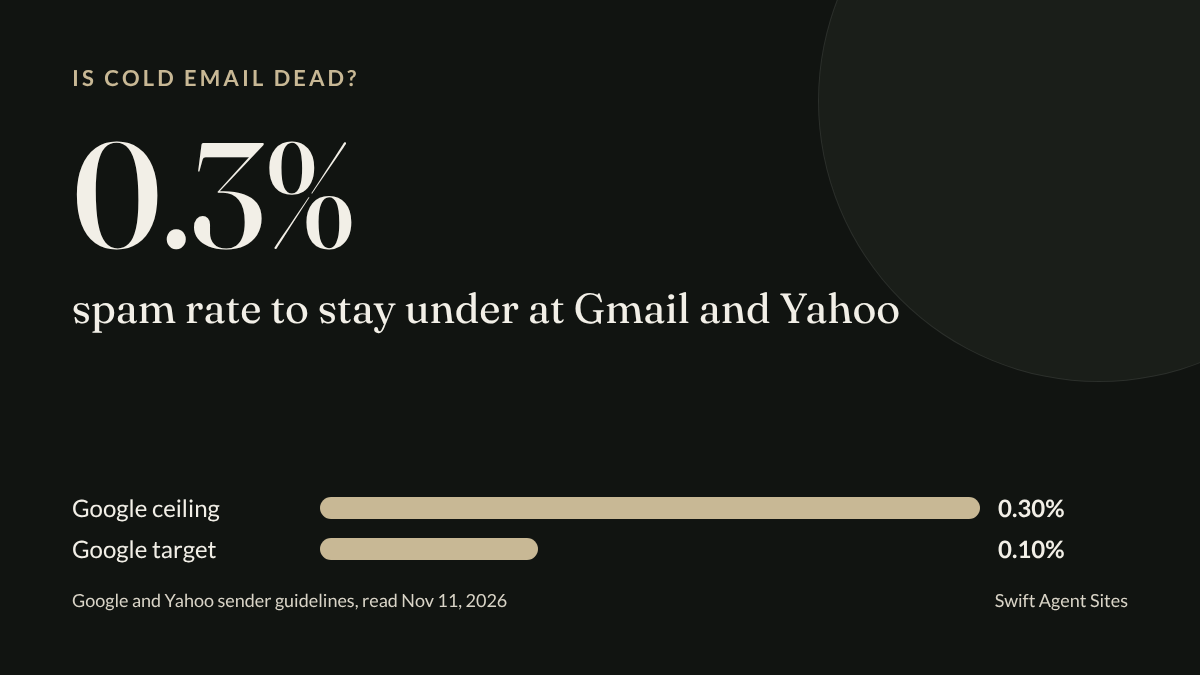
- Spam complaints. Google's sender guidelines say to keep the spam rate reported in Postmaster Tools below 0.10% and to avoid ever reaching 0.30%. Yahoo's sender requirements say to keep it below 0.3%.
- Unsubscribe. Both ask bulk senders to support one-click unsubscribe for marketing mail, with a visible link in the message. Yahoo says to honor requests within 2 days. Google's page gives no deadline that I could find.
- Authentication. Both ask for SPF and DKIM, and for bulk senders a DMARC policy too.
- Who counts as "bulk." Google says more than 5,000 messages a day to Gmail accounts. Yahoo's page gives no number.
Two caveats. Both pages say the requirements can change, and I haven't tested how either provider treats a small sender in practice. And a one-to-one note you write by hand sits far below the bulk line. But the direction is clear: the more your email looks like a blast, the more it's treated like one.
Notice what these rules punish. They punish volume and complaints. They don't punish a plain, relevant message to someone who might want it. That's the point of this whole article.
What does organic do well?
- It compounds. One good post, video or article can keep bringing people in for months, while an email is read once.
- It builds trust before the first conversation. Someone who has read you for a while starts the call already half convinced.
- It makes every other channel work better. A cold message from a name they've seen gets a different reception than one from a stranger.
Where does organic-only break down?
- It's slow. My rule of thumb is six to twelve months of steady posting before it reliably fills a pipeline. That's a typical guess, not a measured figure and not a guarantee. Some people get there faster and many quit first.
- You don't own the audience. A platform can change what it shows people, and your reach follows. I haven't cited a number for this because the changes vary by platform and month.
- It's hard to aim. If your ideal customers are 500 specific companies, posting and hoping those 500 see it is not a plan.
- It's hard to forecast. Hard to say what next month's posts will bring in, which matters if you need revenue this quarter.
What does outbound that still works look like?
Three things. A short list of people who really fit, researched one at a time. A message that mentions something real about them. And low volume, from a properly set-up domain with unsubscribe handled.
Phone can still work in some B2B markets, partly because fewer people use it now. I haven't tested it for this article and I won't put a number on it.
Here's the difference, for an imagined plumbing-supply wholesaler selling to contractors.
The lazy version:
Subject: Quick question
Hi there, I hope this finds you well. We help businesses like yours save time and money with our industry-leading solutions. Do you have 15 minutes this week for a quick call?
It could go to anyone. It says nothing true about the reader, and it asks for their time before giving anything.
The targeted version:
Subject: your Tampa jobs page
Hi Dana, I saw on your site that you're taking on more remodel work in the Tampa area. We stock the fittings those jobs usually run short on, and we deliver next day. Here's a one-page price list. If it's useful, reply and I'll set up a trade account today.
It's shorter, it points to something real, it gives them something to use and the next step is ours to take. Nobody needs to "hop on a call" to answer it.
How do you use organic and outbound together?
- Pick one platform where your buyers spend time, and post there on a schedule you can keep up.
- Engage first. For a few weeks, comment usefully on posts by the people on your short list.
- Then reach out directly by email or message and mention that exchange.
- Follow up with something useful, like a guide, a price list or an answer to a question they asked, instead of "just checking in."
The posting does the warming and the message does the asking.
Which mix fits your business?
- Lean organic if you sell a low-priced or consumer product, you already have an audience, or you have a long runway.
- Lean outbound if you sell to businesses, deals are large, your target list is narrow, or you need revenue this quarter.
- Most businesses: both, weighted by those factors.
The same goes for an independent agent who wants to be the one AI names for a narrow question. Writing answers people can find is the organic half. Telling a few specific people you wrote them is the outbound half. I don't promise either will land you a client.
What should you do next?
Outreach isn't dead. Lazy outreach is. If you want to see what your own website says to a machine before you start, run our free check at swiftagentsites.com/check.
Swift Agent Sites builds agent sites on your own domain, in English and/or Spanish, with hosting and https included, usually live the same day, for $89 a month or $890 a year.
Related:
- AEO vs SEO for real estate agents: what actually changes?
- Will my website still matter in 2027?
- What does guessing an email address cost you?