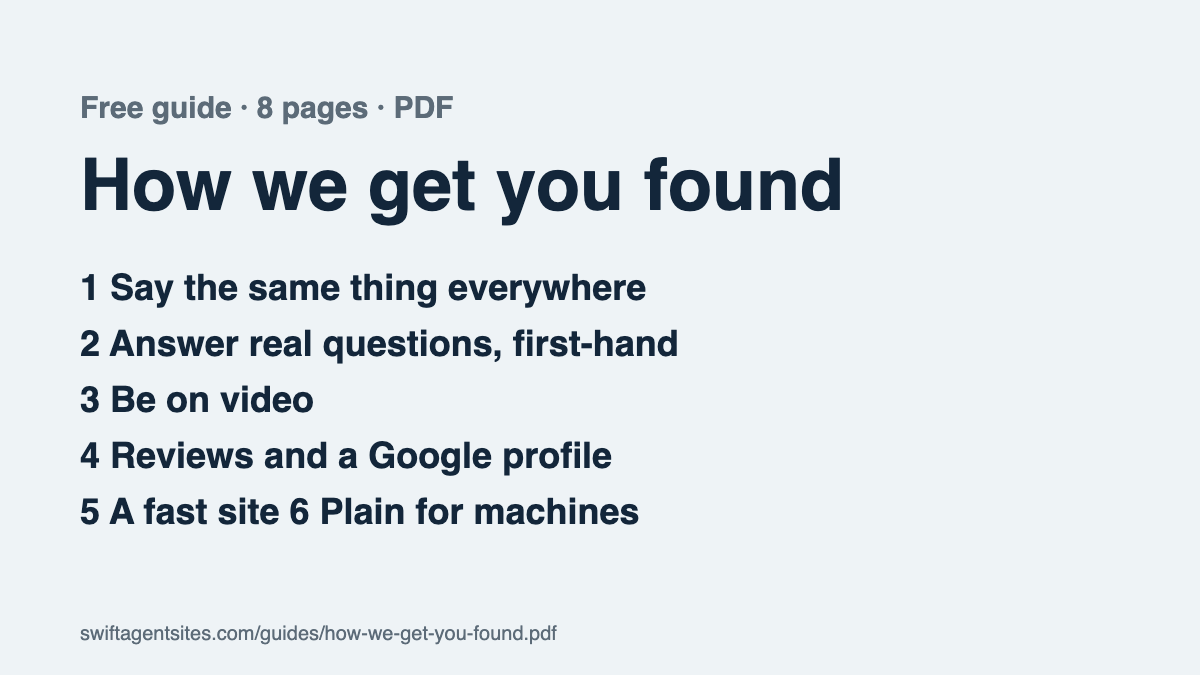
Short answer: make the same facts about you easy to find in many places, answer real local questions in your own words, get on video, look after your Google profile and reviews, and keep your site fast and readable without JavaScript. We put all of it, with the sources, into a free 8-page guide: How we get you found (PDF). No sign-up. Nobody can promise that an AI tool names you, and the guide says so.
Why a guide, and why now?
People still search Google, but more of them now ask ChatGPT, Gemini, Perplexity or Google's AI answers who to call. None of those companies says exactly how it picks the names it gives. What is certain is simpler: an AI tool can't name you from something it never read. The guide is about making sure it can read you, in more than one place.
What matters for being found today?
The first half of the guide is six things, each with what it means in practice and where the evidence comes from:
- Say the same thing everywhere. Your name, phone, areas and specialty should read the same on your site, your Google profile, your license record and every directory. When the facts agree, there is less for an answer to get wrong. That is our reasoning, not a published rule, and the guide labels it that way.
- Answer real questions, first-hand and local. One plain answer per question your clients actually ask, naming the place. Google's helpful-content guidance asks whether content shows first-hand experience.
- Be on video. AI answers cite YouTube, and a small channel isn't ruled out. We wrote more on that in why YouTube videos get cited in AI answers.
- Reviews and a Google Business Profile. For anyone searching nearby, the profile is often the first thing they see. Google says review count and score factor into local ranking.
- A fast site that reads without JavaScript. The words that matter should be in the page itself. Vercel's 2024 study found the crawlers behind ChatGPT and Claude fetch JavaScript files but don't run them.
- Say it plainly for machines too. Structured data, a sitemap, IndexNow and llms.txt. The guide is honest about which of these are documented by the search engines and which (llms.txt) are a cheap proposal no major AI company has said it reads.
What does Swift Agent Sites do about it?
The second half lists every way we help a client get noticed, what each one is and where it shows up:
- Your site: a fast site on your own domain sent as finished HTML, structured data, llms.txt, a sitemap and IndexNow, your Google profile and a review link with a QR code, a "Save contact" card, a blog that can take local posts from our regional hub, and lead pages for your own ads.
- The Swift Agents Network: your license page in our agent directory with the "Verified by Swift Agent Sites" mark (verified means you're our client, not a rating), the Listing Lookout Chrome extension, the regional hubs and their "Ask a local agent" answers, Moving-to and city pages, the Swift Agents Network box on FloodFireCheck, and Sponsored spots, which are a paid label, not a ranking.
Each of those is a place people, search engines and AI tools can read the same facts about you, linking back to your site. None of it is a promise of mentions, rankings or business.
What nobody can honestly promise
That an AI tool will name you, that you'll rank on Google, or that any of this brings inquiries. Rankings depend on competition, your content, links and how well known you are locally. What you can do is make everything in the guide true of you, then ask the AI tools the same questions every month and write down who comes back.
Get the guide
Download How we get you found (PDF, 8 pages, free, no sign-up). If you'd rather we set it up for you, ask for a free preview of your site: we build it first, and you only pay if you want it.
← All insights