Short answer: a page built from your state license record has your full name, the word "agent" and your license number on it, which is what people type when they check you. Your own site may say less. You can't control which page ranks first, but you can make the two point at each other, so a search engine or an AI tool that finds one can find the other. I can't promise either one ranks anywhere.
Why would a license page show up for my name?
Every state publishes real estate licenses so the public can check them. Directories, including ours, are built from those files. A page made from the record has your exact name beside your license type, status and brokerage. A search for "Jane Smith real estate agent" matches that closely. Your own home page might say "Welcome" and "Homes in Davie," with your name in a small footer.
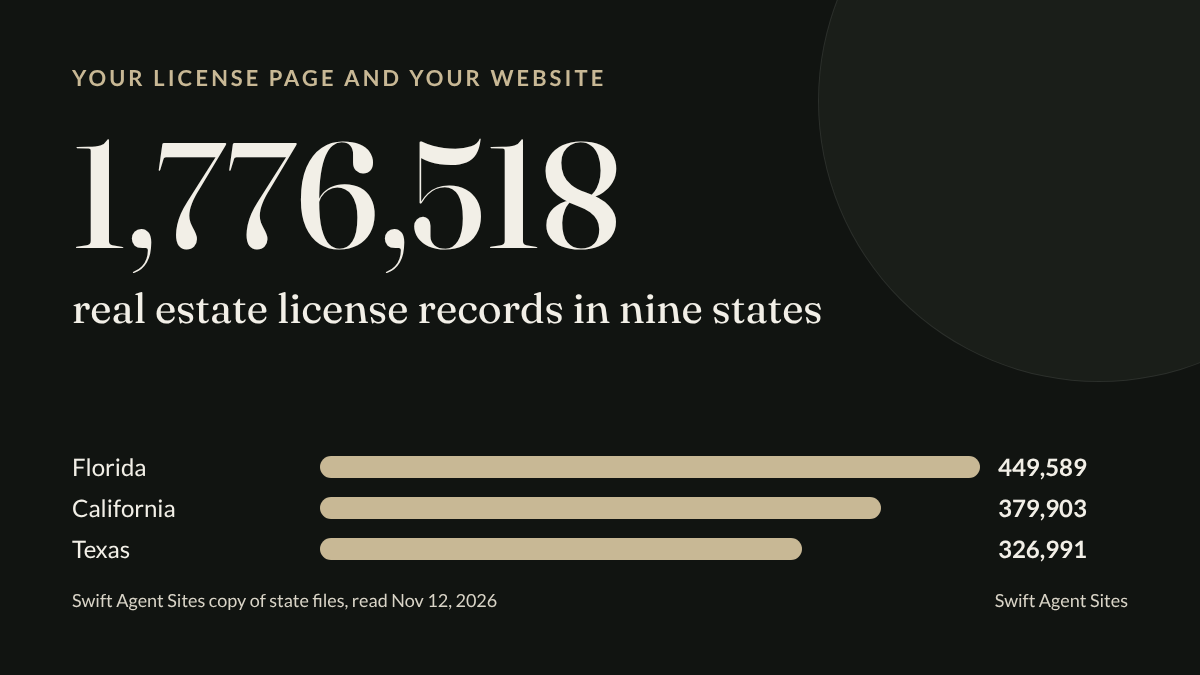
On November 12, 2026, Swift Agent Sites' copy of nine state real estate files held 1,776,518 license records (Florida 449,589, California 379,903, Texas 326,991, Arizona 221,493, New York 118,886, Connecticut 109,881, Illinois 72,883, Colorado 66,887, Delaware 30,005). That's a count from our database, not a count of anyone looking. It means that in those states, most agents already have a page about them that they didn't write. Our license check shows what the public sees. I haven't measured how often those pages beat agents' own sites, so I won't tell you how often it happens.
What does Google use to connect pages about the same person?
Google's ProfilePage documentation says the markup identifies the person or organization a page is about, and recommends a sameAs property for "other external profiles or home pages" of the same entity. It also recommends a dateModified for when the profile was last changed. That's Google describing how to label a profile page, not a promise about rankings. Google's note on site names adds that it considers "references to it that appear on the web," so a page elsewhere that names your site can feed what Google understands about it.
For you, the practical version is plain: give your site and your license page the same name, license number and brokerage, written the same way, and link each to the other.
How do I link my website and my license page?
- Find your page. Search your name at your state's lookup and in our license check. Note how your name is spelled.
- Match your site to it. Put your name exactly as licensed, your license number and your brokerage in text on your home page and your about page, not in an image. Many states require the number anyway, see what's required on a real estate website.
- Link from your site to the page that shows your license, with the words "License #123456, verify with the state." That gives a person and a crawler one clear step to the record.
- Get your site linked from the license page. A state record won't link to you. On a Swift page for a member, there is a Verified mark and a link to the member's website. That is the part you can't do alone.
- Put the same phone and website everywhere you appear: Business Profile, brokerage page, social bios.
What does the Swift Agent Network add?
On the Swift Agent Network, the basic listing is free. It puts the member mark on your license page, a link to your website and your own member page, and real estate agents also get Listing Lookout. Full membership is $500 a year, and adds your photo, phone, bio, a contact form, your state hub and FloodFireCheck. We check the license is yours before anything shows. See how it works. The network is for licensed businesses, and it isn't for you if you don't want a public page about you.
The Agent Website, $890 a year, includes full membership. If you'd rather have your own site built, ask for a free preview. The mark and link show only after we have matched the license; Verified is not a rating.
A checklist
- My name on my site matches my license, letter for letter.
- My license number is in text on my home page.
- My site links to the state's verify page.
- My license page links to my site.
- My phone and website match on every profile.
Then run the free site check, which reads your pages the way a crawler does. Nobody can promise which page a search engine or AI tool will put first.
Related:
- What do AI tools read on a real estate agent's website?
- What's required on a real estate website?
- What does California require on a California real estate agent's website?