Short answer: Your eight-digit license number and your responsible broker's name have to be on the site. If more than one licensee's name appears, each licensee needs a number. The rule is short and it names websites directly. It doesn't ask for specific links or a disclosure page.
The rule is Title 10, California Code of Regulations, section 2773, from the Department of Real Estate (DRE). I read it on 10 November 2026 on Cornell's Legal Information Institute, which lists its last amendment as filed 28 March 2019 and operative the same day. I couldn't open the DRE's own advertising pages today, so I haven't checked how the DRE explains the rule, and I haven't read the statute behind it. This is a plain-English summary, not legal advice, and your broker's policy may be stricter.
What has to be on the page?
- Your license identification number. The rule says a broker or salesperson must disclose their "eight (8) digit real estate license identification number" on solicitation materials meant to be a consumer's first point of contact. California numbers often start with a zero, so write all eight digits, like 01234567, and don't drop the leading zero.
- Your responsible broker's name. The rule asks for the name of the broker you work under. The broker's own license number is optional.
- A number for each licensee shown. If a second agent's name appears, that agent's number does too.
Does a website count?
Yes. The list of covered materials includes websites the licensee owns, controls or maintains, along with business cards, flyers, mail, print and electronic ads, and signs that show a licensee's name. A personal site is the clearest case.
Where should the number go?
The rule doesn't pick a spot on a web page. It does say that in written ads the number can't be set in smaller type than the smallest type in the material. A tiny gray footer line is the risk. I'd put the number and the broker's name in the same contact block as your phone and email, at body size, and reuse that block in the header, the contact page and the footer.
What about a team page?
I'm not covering team names. The text of this rule doesn't mention them, and I couldn't read the DRE's guidance today. What the rule does say applies to a team page: every licensee whose name appears needs a number. So if your team page lists five agents, five numbers go with them. Ask your broker about team naming.
Does Zillow or Instagram count?
The rule covers ads where you control the content and presentation. Content another party controls is excluded, until you adopt it by forwarding or distributing it to a consumer. Your own website is on the controlled side. A listing on a portal that formats it for you is less clear, and that's a question for your broker.
How many agents does this touch?
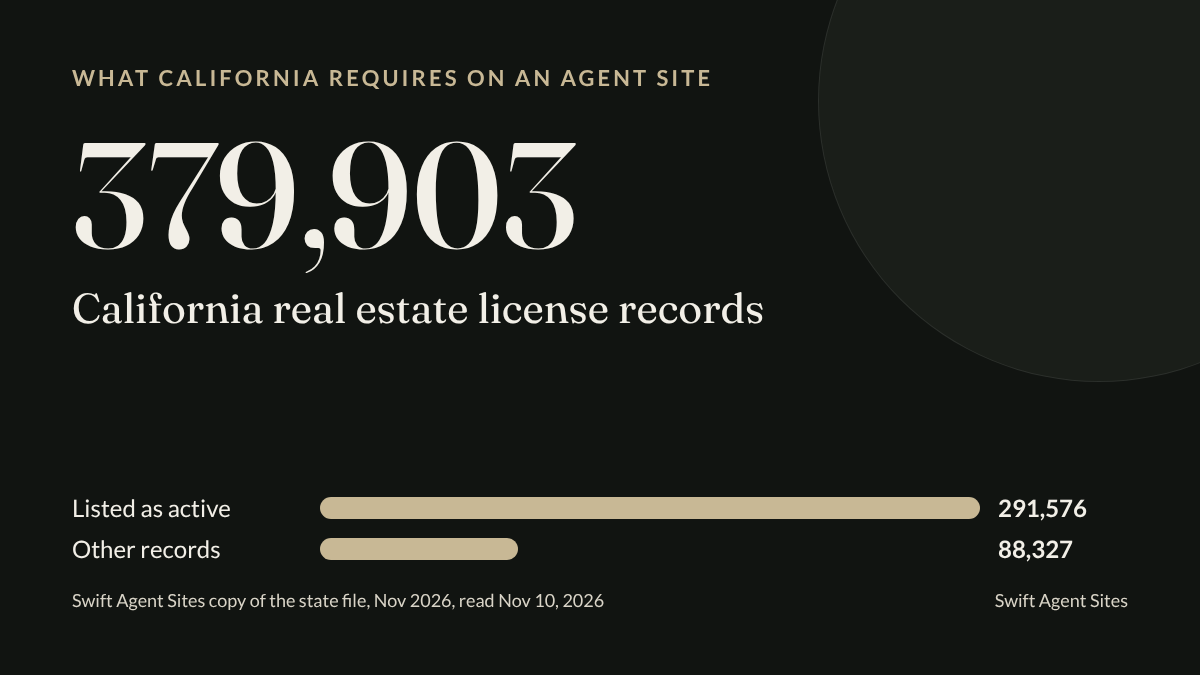
A lot. In Swift Agent Sites' own copy of the California real estate license file, taken in November 2026 (cycle 2026-11, queried 10 November 2026), there are 379,903 license records, and 291,576 of them are the ones our public directory lists as active. The counts include every license type in the file, not only salespersons, and one person can hold more than one record. They count licenses, not websites.
Where does AI come into it?
The rule isn't about being found. But a license number and a broker's name are exactly the plain facts an AI tool can check and repeat, and you can look up a California license on the state's own site. When your number is text on the page, anyone, human or machine, can match you to the public record. Nobody can promise a tool will name you, so test it: our free check at swiftagentsites.com/check shows what a page says to a machine.
A five-minute check for your own site
- Find every place your name appears: home page, about page, contact page, footer.
- Is your full eight-digit license number on the site, with the leading zero?
- Is your responsible broker's name beside it?
- Is the number set in type as large as the smallest text on the page?
- If other agents appear, does each one have a number?
- Show the result to your broker, who will know their own policy.
Swift Agent Sites builds agent sites on your own domain, in English and/or Spanish, with hosting and https included, usually live the same day, for $89 a month or $890 a year. Your broker still signs off on what a California site says.
Related:
- What's required on a real estate website?
- What does Florida require on a Florida real estate agent's website?
- What does TREC require on a Texas agent's website?