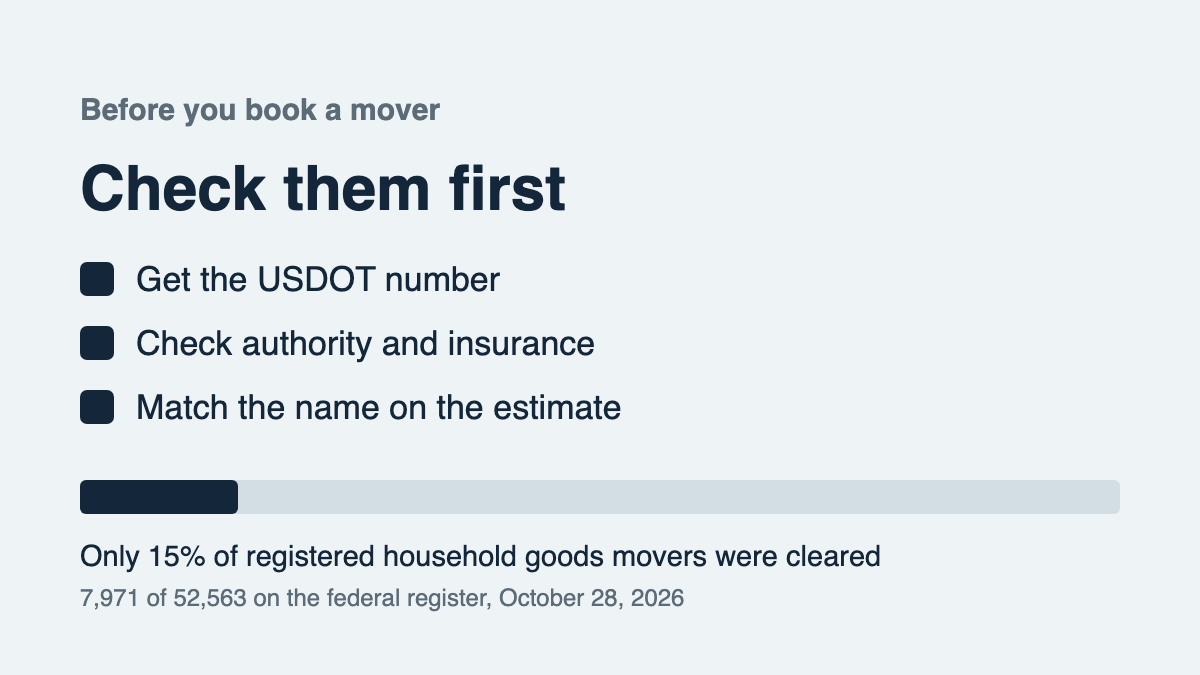
Short answer: check the company before you pay anything, because your leverage ends once they have your things. Get the mover's USDOT number and look it up on our free mover check. It shows whether they hold operating authority, are registered for household goods, have insurance on file, and have a revocation pending.
What did the KMBC investigation find?
KMBC 9 News in Kansas City has been running a series called Relocation Ripoff. In its latest report, a moving truck driver speaking anonymously describes bait-and-switch pricing and movers holding belongings for more money, including stalling a delivery to run up storage fees. "It's a mind game," he told the station.
KMBC also reports on a couple whose $9,000 estimate became $24,000, and who still didn't have their belongings months later. And it quotes moving industry researchers at Trunk as saying that in fiscal year 2026, federal regulators investigated 106 household goods carriers and took no enforcement action against them, though they did act against two brokers. FMCSA told the station it keeps working with law enforcement to investigate bad actors and hold violators accountable.
The story also covers "chameleon carriers," companies that shut down after scamming customers and reopen under a new name. That's why a good-looking website or a stack of reviews doesn't tell you enough.
How many movers are actually cleared to move a home?
Fewer than you'd think. When we counted the federal register on October 28, 2026, 7,971 of the 52,563 companies registered to move household goods were cleared: active authority, liability insurance on file and no revocation pending. That's 15%. Many of the rest may simply be inactive, so it doesn't mean the other 85% are scammers. It does mean a name on the register proves very little until you check its status.
What should I check before I book?
- Get the USDOT number. Every interstate mover has one, and it belongs on their website and paperwork. If they won't give it to you, that's your answer.
- Look it up. Check for active authority, household goods registration, insurance on file and no revocation pending.
- Find out who's actually moving you. A broker arranges a move and hires a carrier, and a broker's bond doesn't authorize anyone to haul your furniture. Ask which carrier will load the truck, and check that name too.
- Match the names. The name on your estimate should match the name on the filing. If it doesn't, ask why before you pay.
- Get the estimate in writing, and ask whether it's binding or non-binding.
Our check reads filings. It doesn't rank movers or recommend them, and a current filing can still belong to a business that's bad to hire. Treat a failed check as a reason to walk away, and a clean one as just the first step.
What if a mover holds my things for more money?
FMCSA says a carrier can't demand more than 100% of a binding estimate, or 110% of a non-binding one, at delivery on an interstate move. Any balance can be billed later. That's why the written estimate matters: without one, you have much less to stand on.
Where do I file a complaint?
For an interstate move, file with FMCSA's National Consumer Complaint Database. For a hostage complaint, it asks for your written estimate, your bill of lading and proof that you paid or offered payment, so keep copies. KMBC's story includes criticism of how that database handles complaints, so you may also want to contact your state attorney general. Moves within one state fall to state agencies.
Is a low quote a red flag?
Treat it as a question to ask. A bait-and-switch starts with a price that looks good. Get more than one written estimate, and ask the low bidder what could make the final price go up.
Related:
← All insights