Short answer: no. You sell homes or insurance, and AI doesn't change that. It changes how people find you and check you out, which makes your basics matter more, not less. The agents who come out ahead won't be "AI-first." They'll be customer-first, with a website that does the boring things right.
Why does everyone say you have to be AI-first?
We've heard this before. Around 2016, every company was told it had to become a tech company, and a pizza chain called itself a tech company that happens to sell pizza. It made good headlines. It didn't make anyone's pizza better.
Now the same pitch has come back with AI in it. You'll see agents told to rebuild their business around chatbots, AI-written listings and AI lead tools, often by people selling exactly those things. Some of those tools are useful. But no agent ever lost a client because they didn't call themselves "AI-first." Nobody calls themselves electricity-first either.
So what actually changes for an agent?
Where people look. More buyers, sellers and retirees now ask ChatGPT, Google's AI answers or Perplexity a question before they search, and some of them go from the answer straight to a name. When they do, two things happen:
- The AI tool reads your site, or tries to, to work out who you are, where you work and what you do.
- The person checks you out: they open your site, look at it on their phone, and decide whether to call.
Neither of those needs anything new from you. They need what a good website always needed, done properly. Nobody can promise that an AI tool will name you. What you can control is whether your site gives it, and the person behind it, a clear and correct picture.
What does "customer-first" mean for my website?
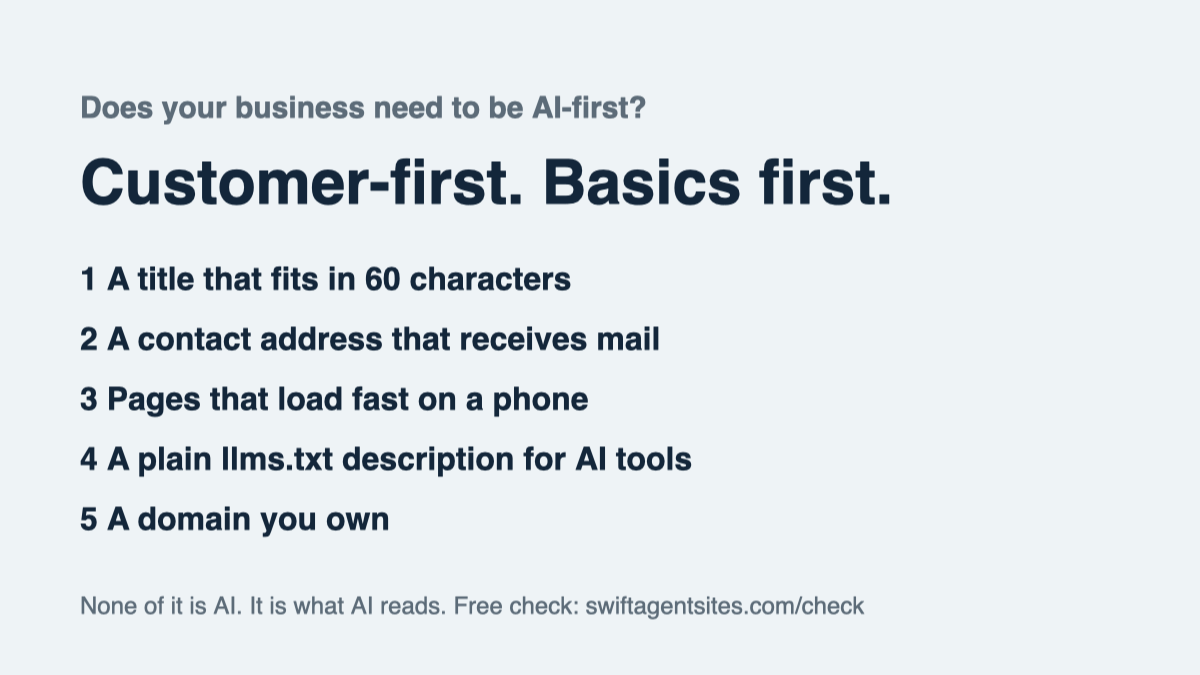
Five boring things. We check every one of them in our free website check, and this week it found problems on one of our own client sites, so don't assume yours is fine:
- A title that fits. Google shows about the first 60 characters of a page title. If yours is longer, the end gets cut, and the end is usually the town you work in.
- An address that receives mail. If the email domain on your site has no mail server, every message to it bounces, and the person who wrote to you gets the bounce, not you. Check that the address on your site actually works.
- Pages that load fast on a phone. Big photos are the usual reason they don't. A picture at the top of your home page should be a few hundred kilobytes, not several megabytes. Google's PageSpeed Insights gives you a score in a minute.
- A plain description for AI tools. An llms.txt file is a short text file at the root of your site that says who you are, where you work and which pages matter. It's new and optional, and no major AI company has said it decides who gets named. It takes ten minutes, and without it the tools have to guess.
- A domain you own. If your site lives on someone else's address, or your domain is registered to a web designer you've lost touch with, all of the above can disappear the day it lapses.
None of that is AI. It's the foundation AI reads, and that's exactly why it matters more now.
Should I wait, then?
No. Do the basics now, because they're cheap and they help with or without AI. Then try new things in small steps: a short video answering a question you get every week, a page for each neighborhood you know well, a blog post a month. See what people actually ask you about, and do more of that.
Be wary of anything sold as an "AI transformation." A lot of what's labelled AI is an old tool with a new name, and moving first isn't the same as winning. Google wasn't the first search engine. The agents who get this right will be the ones who stayed useful to their clients and kept their foundations in order.
Where do I start?
Run your site through the free website check. It takes about a minute, saves nothing, and tells you which of the five basics above your site gets wrong. Every fix it suggests is one you or your web person can make yourselves.
If you'd rather talk it through, book a call with me.
— James Brazil, Swift Agent Sites
← All insights